
Exploring Limb Positions and Support Surface Rotations in Prosthetic Users’ Rehabilitation
This study examines the impact of various limb positions and support surface rotations on the bilateral electromyogram (EMG) response latency of unilateral transtibial prosthesis users. The research highlights the significance of weight distribution on a level-mounted force platform, indicating how toes-up and toes-down orientations in the sagittal plane affect balance and stability during testing. By analyzing three scenarios—intact limb, both limbs, and prosthetic limb—this work contributes essential insights into rehabilitation practices for individuals using prosthetics.

Exploring Limb Positions and Support Surface Rotations in Prosthetic Users’ Rehabilitation
E N D
Presentation Transcript
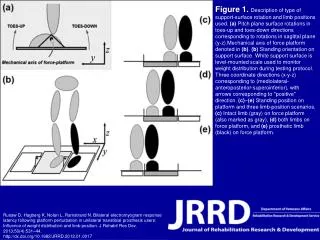
Figure 1. Description of type of support-surface rotation and limb positions used. (a) Pitch plane surface rotations in toes-up and toes-down directions corresponding to rotations in sagittal plane (y-z).Mechanical axis of force platform denoted in (b). (b) Standing orientation on support surface. White support surface is level-mounted scale used to monitor weight distribution during testing protocol. Three coordinate directions (x-y-z) corresponding to (mediolateral-anteroposterior-superoinferior), with arrows corresponding to "positive" direction. (c)–(e) Standing position on platform and three limb-position scenarios. (c) Intact limb (gray) on force platform (also marked as gray), (d) both limbs on force platform, and (e) prosthetic limb (black) on force platform. Rusaw D, Hagberg K, Nolan L, Ramstrand N. Bilateral electromyogram response latency following platform perturbation in unilateral transtibial prosthesis users: Influence of weight distribution and limb position. J Rehabil Res Dev. 2013;50(4):531–44.http://dx.doi.org/10.1682/JRRD.2012.01.0017
