Download
1 / 16
160 likes | 291 Vues
This study by Alexander Bakker examines the decreasing trend in wind energy yield from turbines in a changing climate. It analyzes geostrophic wind speed as a predictor and explores past trends through reanalysis and the North Atlantic Oscillation (NAO) index. The findings reveal that trends in wind yields are not solely due to climatological changes, and highlights the role of geostrophic wind speed and NAO as significant predictors for relative wind yields in the North Sea. The paper also investigates aspects of temporal dependency and the increasing discrepancies observed.

E N D
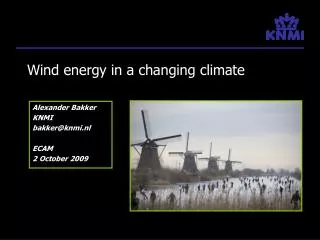
Wind energy in a changing climate Alexander Bakker KNMI bakker@knmi.nl ECAM 2 October 2009
Contents • Geostrophic wind speed as predictor • Past trends (Reanalysis & NAO index)
Geostrophic wind speed • ERA40 2.5 x 2.5 1958-2001 • ERA Interim 1.5 x 1.5 1989-
R (Windex,geostrophic wind) ERA Interim ERA40
Trends geostrophic wind speed (m/s)/yr ERA40 ERA Interim
P-value trends geostrophic wind speed ERA40 ERA Interim
NAO index Jones PD, Jonsson T and Wheeler D (1997) Extension to the North Atlantic Oscillation using early instrumental pressure observations from Gibraltar and South-West Iceland. Int. J. Climatol. 17, 1433-1450. 3
Conclusions • Trends in wind yields are not caused by climatological trends • Geostrophic wind speed and NAO index are good predictors for “relative” wind yields in the North Sea • Is there temporal dependency (autocorrelation, persistence)?