Download
1 / 9
90 likes | 215 Vues
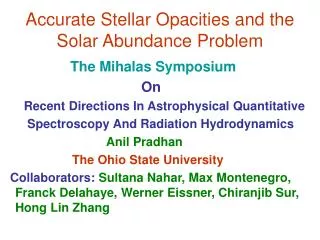
This paper discusses the collaborative efforts in atomic physics and astrophysics, focusing on the Opacity Project (OP) and its impact on stellar modelling. Key advancements include the development of new opacities that incorporate inner shell processes and the analysis of differences between OP and OPAL opacities regarding radiative accelerations. The paper highlights applications to solar composition and micro-diffusion, addressing issues such as gravitational settling and the implications for stellar structure and evolution. Future directions involve improved observational data, new experiments, and enhanced computational models.

E N D
From Accurate Atomic Data to Elaborate Stellar Modeling Franck Delahaye LUTh (Observatoire de Paris, France) Collaborations: Atomic Physic – Opacity: Claude Zeippen (LUTh) Anil Pradhan (Ohio State) Claudio Mendoza (IVIC) The Opacity/Iron/RmaX Project team Astrophysics – Stellar Physic: Marc Pinsonneault (Ohio State) Georges Alecian (LUTh) Donald Terndrup (Ohio State) Sylvaine Turck-Chièze (CEA) High Accuracy Atomic Physics in Astronomy, August 7 – 9, 2006, ITAMP
Drake et al. 2005 (Nature 436/Chandra) Atomic Physic and Astronomy
Results: Opacities & Accelerations OP Stellar composition Delahaye & Pinsonneault 2006 (ApJ in press) • New opacities OP include inner shell processes. • OP Opacities available for high T - domains Stellar interior • Now 2 main sources of opacities: OP and OPAL • Good agreement in R but important differences in accelerations • Applications → Solar composition, micro-diffusion 1s22s22p6 +h 1s22s22p5nlvalence electron 1s22s22p6 +h1s2s22p6nlinner shell electron Opacities: OP vs OPAL Radiative accelerations: OP vs OPAL ⊙ Badnell et al. 2005 MNRAS 360: 458 Delahaye & Pinsonneault 2005 ApJ 625:563
Solar composition Delahaye & Pinsonneault 2006 (ApJ in press )
Behr et al. 2000 (ApJ 531:L37) Radiative Accelerations & Abundances Anomalies Radiative Acceleration Gravitational settling
Radiative Accelerations: OP vs OPAL Comparison OP-OPAL For a given stellar structure which Simulates HB or intermediate mass stars Trend: Z Diff . Delahaye & Pinsonneault 2005 ApJ 625, 563
Detailled comparison between predictions and observations • Disagreement • Stellar wind, mixing • How about uncertainties in micro-diffusion? • Settling↓ Levitation↑. • Error in Acceleration can change amplitude and even sign • AccFe(OP) < AccFe (OPAL) Turcotte et al. 1998 (ApJ 504:559-572)
Age Radiative Acceleration & Stellar interior Surface CZ: Convection Zone Black: CZ Fe CZ Fe CZ M=1.7M⊙ M=1.5M⊙ centre Radiative Acceleration Gravitational Settling Fe CZ M=2.5M⊙ Richard et al. 2001 (ApJ 558:377-391)
Future NEEDS: Data and Comparisons Direct → Experiments, other calculations Indirect → Modelling . Context • More observations of high resolution to come (XMM - Chandra - XEUS - ASTROE2 - COROT - MOST – LBT). Atomic Physics • Data for low ionization states of Fe, Co and Ni. • Lasers and opacities: Experiment at ILP (CEA) (Proposal accepted) Astrophysics • Influence of atomic data on stellar modelling. • Development of the new standard of stellar code (including micro-diffusion) Data Bases • Development of codes et services for stellar modelling. • Toward VO standard of the OP/IP databases