Download
1 / 19
190 likes | 330 Vues
This article explores two primary methods of dating in geologic time—relative and absolute dating. Sir Charles Lyell's significance in establishing uniformitarianism is discussed, alongside the seven principles of relative dating including original horizontality and superposition. It also examines types of unconformities, such as disconformities and angular unconformities, and highlights the importance of fossils in correlation and identifying index fossils. Additionally, the article covers the discovery of radioactivity and its role in radiometric dating, emphasizing the development of the geologic time scale.

E N D
__________ and _______________ studied features preserved in rocks & present-day geologic processes. Why is Sir Charles Lyell important? Uniformitarianism
Seven principles of relative dating: • . • . • . • . • . • . • . Who formulated these principles? Who expounded upon these principles?
Original horizontality Superposition Lateral continuity Grand Canyon, Ariz.
A B Inclusions In A & C, granite contains inclusions & is younger than the inclusions. • In B, sandstone is younger than the granite b/c it contains inclusions of granite. Wisconsin C
Ontario, Canada Castaic, Ca Cross-cutting relationships
Types of Unconformities What areconformable contacts? Unconformities What is a hiatus?
What is a Disconformity? • How are disconformities recognized?
What is an Angular unconformity? James Hutton = 1st to recognize & understand the significance of an angular unconformity Siccar Point, Scotland
What is correlation? Why do geologists use correlation? Factors: What are Key beds?
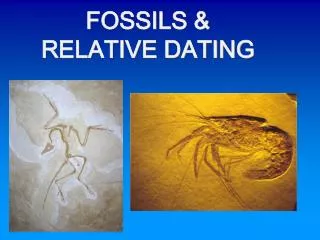
Why are fossils important? What are Index fossils?
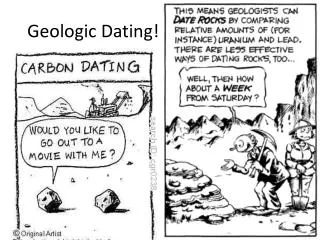
Absolute-Dating • ___________________________discovered radioactivity in 1903. • Radiometric dating • Radioactivity • Isotopes
Radioactive decay Alpha decay Beta decay Electron capture
Geologic Time Scale www.acs.appstate.edu/~hagemans/timescale.html How was the Geologic Time Scale Developed?
Can sedimentary rocks be dated radiometrically? Explain. How are they dated?