Trigonometry
Trigonometry is the mathematical study of the relationships between angles and sides of triangles. This review covers essential concepts, including radians and degrees, conversion methods, and trigonometric functions (sine, cosine, tangent). Learn how to apply SOH-CAH-TOA to find sides and angles, explore reciprocal identities, and practice with examples. Discover how to simplify expressions using identity formulas such as sum, difference, and half-angle formulas. Perfect for students seeking to grasp the foundations of trigonometry and apply them in various mathematical situations.

Trigonometry
E N D
Presentation Transcript
Trigonometry ACT Review
Definition of Trigonometry It is a relationship between the angles and sides of a triangle.
Radians (x,y) = (Rcos (θ) , Rsin (θ) ) ( 1 cos (30˚) , 1 sin (30 ˚) = The radian is a unit of plane angle, equal to 180/π (or 360/(2π)) degrees It is the standard unit of angular measurement in all areas of mathematicsbeyond the elementary level.
Degrees to Radians Conversion To convert degrees into radians, multiply the degree by ∏/180˚ To convert radians into degrees, multiply the radian by 180˚/ ∏
Conversion Examples Example 1: Convert 60˚ into radians Example 2: Convert ∏/4 into degrees ∏/4* (180˚/ ∏)=45 ˚
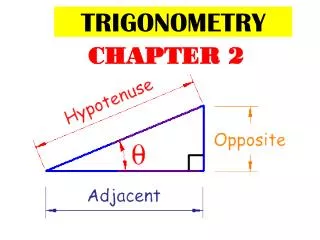
Trigonometry Basics Opposite Side: The side opposite to the angle (θ) Adjacent Side: The side adjacent to the angle (θ) Hypotenuse: The side opposite to the 90˚ angle, which is also the longest side of the triangle
Trigonometry Basics (cont’d.) A useful anagram to help you remember the formulas is SOH CAH TOA. For example, SOH corresponds to sin of angle is equal to opposite over hypotenuse.
Example – Basic Relationships Sin (A) = Opposite/Hypotenuse = 12/13 Cos (A) = Adjacent/Hypotenuse = 5/13 Tan (A) = Opposite/Adjacent = 12/5 Csc (A) = Hypotenuse/ Opposite = 13/12 Sec (A) = Hypotenuse/ Adjacent = 13/5 Cot (A) = Adjacent/ Opposite = 5/12
Reciprocal Identities Csc(θ) is the reciprocal of sin(θ) sec(θ) is the reciprocal of cos(θ) cot(θ) is the reciprocal of tan(θ)
Trigonometry Basics (cont’d.) If you take the thesin,tan,csc or cot of -θ, then it is the same thing as taking the sin,tan,csc or cot of θ and multiplying it by -1. The cos and sec of –θ is the same as cos and sec of θ. If you add a multiple of 2∏ to an angle and determine the value of sin and cos, then the answer will be the same. (Example: sin(5∏)=sin(5 ∏+2 ∏)
Inverse Function Example Thus, y = n/4 or y = 45°
Half Angle Example Example: Find the value of sin 15° using the sine half-angle relationship.
Just like the other identity formulas, cofunction and double angle formulas are mainly used to simplify expressions so that an exact value may be reached.
References [1] http://tutorial.math.lamar.edu/pdf/Trig_Cheat_Sheet.pdf [2] http://www.intmath.com/Analytic-trigonometry/4_Half-angle-formulas.php [3] http://www.sosmath.com/trig/prodform/prodform.html [4] http://www.analyzemath.com/Trigonometry_2/Use_sum_diff_form.html [5] http://www.intmath.com/Analytic-trigonometry/4_Half-angle-formulas.php [6]http://www.tutorvista.com/content/math/trigonometry/trigonometry/math-trigonometry.php [7] http://www.nipissingu.ca/calculus/tutorials/trigonometry.html [8]http://www.algebralab.org/lessons/lesson.aspx?file=Trigonometry_TrigLawSines.xml [9] http://www.cimt.plymouth.ac.uk/projects/mepres/step-up/sect4/index.htm