Download

1 / 12
120 likes | 237 Vues
This document provides a comprehensive overview of colligative properties, which depend on the concentration of solute particles rather than their identity. Key types include freezing point depression and boiling point elevation, illustrating how solute particles affect the melting and boiling points of solutions. Applications such as salting icy roads, making ice cream, and using antifreeze in vehicles are discussed. The document also contains calculations for determining boiling and freezing points using molality and van't Hoff factor, essential for understanding solution behavior.

E N D
Ch. 15 - Solutions III. Colligative Properties(p.552)
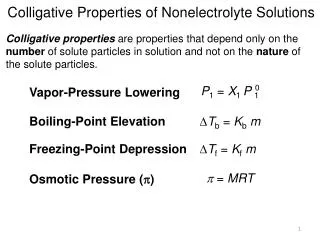
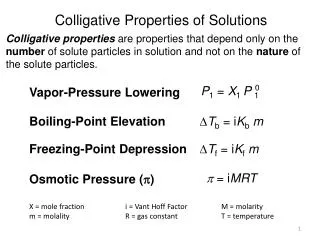
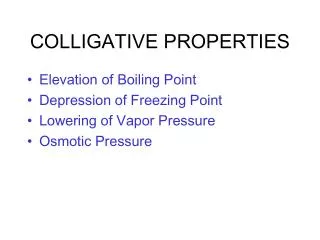
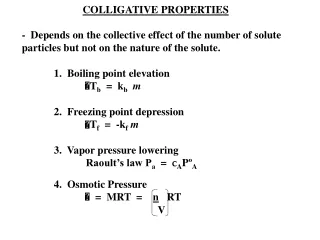
A. Definitio`n • Colligative Property • property that depends on the concentration of solute particles, not their identity
B. Types • Freezing Point Depression (tf) • f.p. of a solution is lower than f.p. of the pure solvent • Boiling Point Elevation (tb) • b.p. of a solution is higher than b.p. of the pure solvent
B. Types Freezing Point Depression View Flash animation.
B. Types Boiling Point Elevation Solute particles weaken IMF in the solvent.
B. Types • Applications • salting icy roads • making ice cream • antifreeze • cars (-64°C to 136°C) • fish & insects
C. Calculations t: change in temperature (°C) k: constant based on the solvent (°C·kg/mol) m: molality (m) i: # of particles t = k · m · i
C. Calculations • i -# of Particles • Nonelectrolytes (covalent) • remain intact when dissolved • 1 particle • Electrolytes (ionic) • dissociate into ions when dissolved • 2 or more particles
C. Calculations • At what temperature will a solution that is composed of 0.73 moles of glucose in 225 g of water boil? GIVEN: b.p. = ? tb = ? kb = .512°C·kg/mol WORK: m = 0.73mol ÷ 0.225kg tb = (.512°C·kg/mol)(3.2m)(1) tb = 1.64°C b.p. = 100°C + 1.64°C b.p. = 101.64°C m = 3.2m i = 1 tb = kb · m · i
C. Calculations • Find the freezing point of a saturated solution of NaCl containing 28 g NaCl in 100. mL water. GIVEN: f.p. = ? tf = ? kf = 1.86°C·kg/mol WORK: m = 0.48mol ÷ 0.100kg tf = (1.86°C·kg/mol)(4.8m)(2) tf = 18°C f.p. = 0.00°C - 18°C f.p. = -18°C m = 4.8m i = 2 tf = kf · m · i