Understanding Plant Evolution Through Concept Mapping
A concept map is a visual tool for organizing information graphically, illustrating relationships between concepts. This guide focuses on plant evolution, detailing the hierarchy from Charophytes (green algae) through Bryophytes (non-vascular land plants) and Pteridophytes (vascular, non-flowering plants), to Gymnosperms (seed-producing plants) and Angiosperms (flowering plants). Each group includes examples like mosses, ferns, and fruit trees, aiding in the comprehension of plant taxonomy and evolution.

Understanding Plant Evolution Through Concept Mapping
E N D
Presentation Transcript
Concept Map Stephanie Barker Due: June 8, 2010
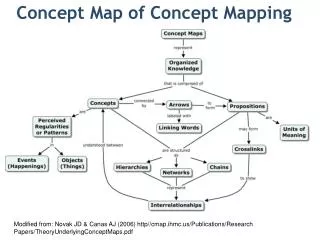
What is it? • A concept map is a visual way to organize information graphically. • Lines are drawn from one concept to another, these lines represent a relationship between the concepts.
Why use them? • Concept maps like other visual graphic organizers aid in clarification of a topic or text.
Plant Terms in the Evolution of Plants Concept Map • Charophytes – Green Algae • Bryophytes – ‘Land Plants’ that do not have a vascular system • Pteridophytes– Vascular system plants that do not flower or produce seeds. • Gymnosperms – Plants with a vascular system that produces seeds not coated with an ovary • Angiosperms – Flowering plants that produce seeds covered by an ovary
Examples of Plants • Charophytes – Green Algae • Bryophytes – • Mosses, Liverwarts, and Hornwarts • Pteridophytes – • Ferns, Club Mosses, Spike Mosses Horsetails • Gymnosperms – • Ginkgophytes, Conifers, Gnetopsids, Cycads • Angiosperms – • Fruit Trees and shrubs
Works Cited • Fisher, D. 2007. 50Content Area Strategies for Adolescent Literacy. Upper Saddle River, NJ: Person Education, Inc. • http://www.hbwbiology.net/quizzes/ch29-early-plants_files/haq2901q.jpg • Tree of Life Web Project • http://tolweb.org/tree/phylogeny.html