Download
1 / 9
90 likes | 226 Vues
This article explores the fundamental principles of chemical equations, focusing on the equation 4Al(s) + 3O2(g) → 2Al2O3(s). It explains the roles of reactants and products, the importance of balancing equations, and the concept of the conservation of mass in chemical reactions. By providing examples and visualizations, readers will gain insights into the physical states of compounds indicated by symbols (s, g, l) and the necessity of coefficients for representative chemical equations in science.

E N D
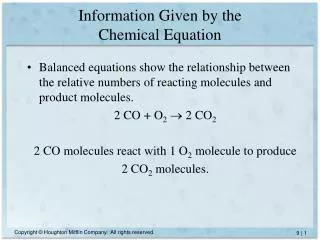
4 Al(s) + 3 O2(g) 2 Al2O3(s) Chemical Equations: Depict the kind of reactants and productsincluding their relative amounts in a reaction. aluminum oxide The letters (s), (g), and (l) are the physical states of compounds. The numbers in the front are called coefficients.
4 Al(s) + 3 O2(g) 2 Al2O3(s) Chemical Equations aluminum oxide sandpaper This equation means: 4 Al atoms + 3 O2 molecules yield 2 molecules of Al2O3
Chemical Equations Because the same atoms are present in a reaction at the beginning (reactants) and at the end (products), the amount of mass in a system does not change. The Law of Conservation of Mass Kotz web
Chemical Equations Because of the principle of the conservation of mass. An equation must be balanced. It must have the same number of atoms of the same kind on both sides. Lavoisier, 1788
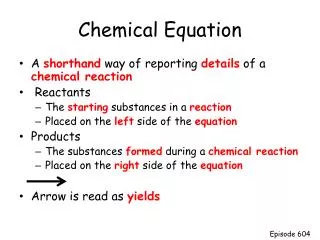
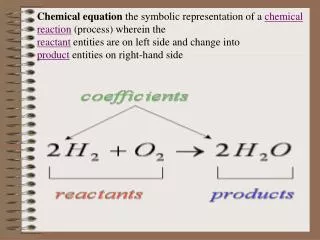
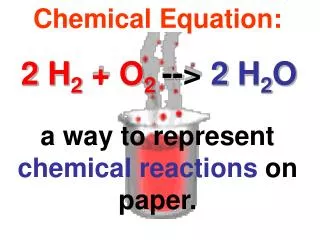
Chemical Equations • Reactants – the substances that exist before a chemical change (or reaction) takes place. • Products – the new substance(s) that are formed during the chemical changes. • CHEMICAL EQUATION indicates the reactants and products of a reaction. REACTANTS PRODUCTS
Cl H H H Cl Cl Cl H reactants products reactants products H H Cl Cl Unbalanced and Balanced Equations H Cl Cl Cl H H H2 + Cl2 2 HCl (balanced) (unbalanced) H2 + Cl2 HCl 2 1 2 2 1 2 2 2
Visualizing a Chemical Reaction 2 2 Na + Cl2NaCl
Meaning of Chemical Formula Chemical Symbol Meaning Composition H2O One molecule of water: Two H atoms and one O atom 2 H2O Two molecules of water: Four H atoms and two O atoms H2O2 One molecule of hydrogen peroxide: Two H atoms and two O atoms