Understanding the Greatest Common Factor (GCF): Methods and Examples
The Greatest Common Factor (GCF) is the largest number that can divide two or more integers without leaving a remainder. You can determine the GCF by listing all factors or utilizing prime factorization. This guide outlines both methods step-by-step. Whether listing factors or using prime factorization, we’ll demonstrate how to find the GCF with various examples. Learn how common factors reveal the GCF and why it's essential in simplifying fractions and solving problems involving multiples.


Understanding the Greatest Common Factor (GCF): Methods and Examples
E N D
Presentation Transcript
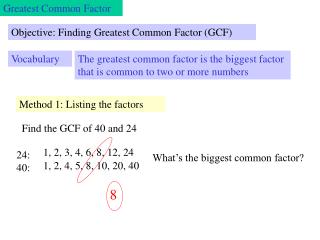
GREATEST COMMON FACTORGCF • The largest factor two or more numbers have in common. • To find the GCF of two or more numbers, you can make a list of all the factors or use prime factorization.
Make a list • List all of the factors of each number. • Identify the common factors. • The greatest of the common factors is the GCF.
Make a list 1, 2, 3, 4,6, 8, 12, 24 24 = 32 = 1, 2, 4, 8, 16, 32 32 1 x 32 2 x 16 4 x 8 24 1 x 24 2 x 12 3 x 8 4 x 6 The common factors are: 1, 2, 4, 8 The GCF = 8
Use Prime Factorization • Write the prime factorization of each number. • Identify all of the common prime factors. • The product of the common prime factors is the GCF.
Use Prime Factorization 2 2 2 3 24 = 32 = 24 ^ 6 x 4 ^ ^ 2 x 3 2 x 2 24=2 x 2 x 2 x 3
Use Prime Factorization 2 2 2 3 24 = 32 = 2 2 2 2 2 32 ^ 4 x 8 ^ ^ 2 x 2 2 x 4 ^ 2 x 2 32=2 x 2 x 2 x 2 x 2
Use Prime Factorization 2 2 2 3 24 = 32 = 2 2 2 2 2 2 2 2 x x 4 2 x The GCF = 8
Use Prime Factorization 3 5 15 = 45 = 3 5 3 3 5 x 15 = 3 x 5 15 45 = 3 x 3 x 5 The GCF = 15
Use Prime Factorization 2 3 6= 44 = 2 2 11 2 6 = 2 x 3 44 = 2 x 2 x 11 The GCF = 2
Use Prime Factorization 5 5 25 = 56 = 2 2 2 7 25 = 5 x 5 56 = 2 x 2 x 2 x 7 The GCF = 1
Use Prime Factorization 5 5 25 = 56 = 2 2 2 7 If there are no common prime factors the GCF is one. The GCF = 1
Use Prime Factorization 11 11 = 22 = 11 2 11 11 = prime number 22 = 2 x 11 The GCF = 11
Use Prime Factorization 2 2 3 12 = 18 = 60 = 2 3 3 5 2 2 3 2 3 12 = 2 x 2 x 3 x 18 = 2 x 3 x 3 60 = 2 x 2 x 3 x 5 The GCF = 6