zebra mussel impacts on Hudson
410 likes | 412 Vues
a technical presentation (for scientific audiences) describing what zebra mussels have done to the Hudson River ecosystem


zebra mussel impacts on Hudson
E N D
Presentation Transcript
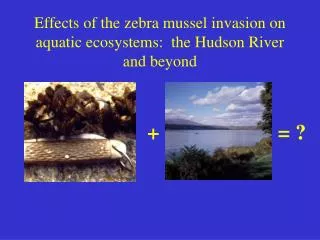
Effects of the zebra mussel invasion on aquatic ecosystems: the Hudson River and beyond + = ?
Nina Caraco Jon Cole Stuart Findlay Mike Pace Hudson River Foundation National Science Foundation Sea Grant Pete Ambrose David Bastviken Jim Carlton Nils Carlsson Sarah Fernald David Fischer Kathy Hattala Dean Hunter Jonathan Jeschke Andy Kahnle Greg Lampman Karin Limburg Heather Malcom Ed Mills Acknowledgements • Ben Peierls • Jon Powell • Peter Raymond • Hudson Roditi • Mark Scheuerell • Lane Smith • Tom Smith • Jan Stevenson • Cathy Wigand • AND MANY OTHERS!!!
Boring background An introduction to the Hudson River A little zebra mussel biology Tedious details A tour of zebra mussel effects on the Hudson Irresponsible speculation How do effects vary across ecosystems? How do effects vary over time? Feeble conclusions
The freshwater tidal Hudson H. Malcom
Methods • Pelagic variables • Weekly or biweekly, at Kingston, 1986- • 4-6 times/year, along river, 1986- • Benthic variables • 1-2 times/year, along river, 1990-
1. Zebra mussels consumed resources (oxygen) Caraco et al., 2000
2. Planktivores suffered Macrozooplankton (Pace et al.) Deepwater macrobenthos
Source of wonderful fish data • Hudson River electric utilities: (1) Ichthyoplankton survey (post-yolk-sac larvae), stratified random design, weekly for 26 years (19 pre-invasion, 7 post-invasion), numbers and body lengths of 7 species; (2) Beach-seine surveys (young-of-year), stratified random design, every 2 weeks in late summer for 26 years, numbers of 15 species, body lengths of 6 species • New York State Department of Environmental Conservation: Beach-seine surveys (young-of-year), selected index sites, every 2 weeks in late summer for 15 years (8 pre-invasion, 7 post-invasion), body lengths of 5 species
“Abundance” is mean riverwide number of fish over standard period of time • “Distribution” is ratio of number of fish above RKM 100 (Newburgh) and number of fish below RKM 100 for each species • “Growth” is apparent growth, based on field measurements of length • Covariates include year (time-trends), freshwater flow, water temperature • Technique is multiple regression, using model-averaging
3. Resources formerly used by phytoplankton increased Caraco et al.
Conclusions (1) • Zebra mussels consumed resources (food, oxygen) • Planktivores suffered • Resources formerly used by phytoplankton increased • The littoral food web flourished • Resources increased in zebra mussel beds
Conclusions (2) • A single species can have large, far-reaching effects on ecosystems • Species introductions are one of the most important ways by which people affect the Hudson • Phytoplankton are important in the Hudson • Submersed vegetation may buffer aquatic ecosystems against changes in phytoplankton • The food web of the Hudson is tightly connected • Species invasions may be a useful scientific tool to help us understand large, non-manipulable ecosystems (no, I did not introduce zebra mussels to the Hudson!)
How do the effects of an alien species vary across ecosystems?
How do the effects of an alien species vary across ecosystems? • What are the characteristics of ecosystems that modulate alien species impacts? • Can we develop quantitative models to predict such impacts? • Are we collecting the data needed to parameterize or test such models?
Why should the effects of alien species change over time? • Evolution in the alien or in the community that is invaded • Species shifts in the community that is invaded • Cumulative effects • Interactions with temporally variable drivers
Why should the effects of alien species change over time? • Evolution in the alien or in the community that is invaded • Species shifts in the community that is invaded • Cumulative effects • Interactions with temporally variable drivers • All of these probably are common and important!, but • Long-term studies of alien effects are rare
What’s up? • What mechanisms allow the long-term coexistence of zebra mussels and other bivalves? • How long does it take for these mechanisms to come into play? • Will they save North America’s native bivalves? • Do the Hudson River data represent the beginning of this dynamic, or are they an ephemeral blip? • How important, and how fast, are temporal changes in the effects of alien species?
Conclusions • We have some good case studies on the ecological effects of aliens • We know less about how those effects vary across ecosystems, time, and species • Get to work!