Enhancing Prescription Charts: A Comprehensive Approach to Safer Healthcare Practices
This study explores the inadequacies of current prescription charts in the UK, which often lack consideration for programming tasks essential for safe medical practice. It emphasizes that simply asking nurses about their processes is insufficient, as they may struggle to articulate implicit practices. The research advocates for observational studies, conceptual model elicitation, and examination of ad-hoc artifacts to better understand the interaction between users, devices, and supporting materials. The aim is to design prescription charts that effectively support safe programming of infusion devices.

Enhancing Prescription Charts: A Comprehensive Approach to Safer Healthcare Practices
E N D
Presentation Transcript
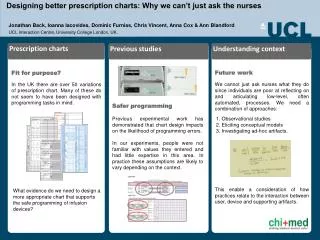
Designing better prescription charts: Why we can’t just ask the nurses Jonathan Back, Ioanna Iacovides, Dominic Furniss, Chris Vincent, Anna Cox & Ann Blandford UCL Interaction Centre, University College London, UK. Prescription charts Understanding context Previous studies consider how practices relate to the interaction between user, device and supporting artifacts. Fit for purpose? Future work We cannot just ask nurses what they do since individuals are poor at reflecting on and articulating low-level, often automated, processes. We need a combination of approaches: In the UK there are over 50 variations of prescription chart. Many of these do not seem to have been designed with programming tasks in mind. Safer programming Previous experimental work has demonstrated that chart design impacts on the likelihood of programming errors. In our experiments, people were not familiar with values they entered and had little expertise in this area. In practice these assumptions are likely to vary depending on the context. 1. Observational studies 2. Eliciting conceptual models 3. Investigating ad-hoc artifacts. This enable a consideration of how practices relate to the interaction between user, device and supporting artifacts. What evidence do we need to design a more appropriate chart that supports the safe programming of infusion devices? DRIVE