Download
1 / 7
70 likes | 198 Vues
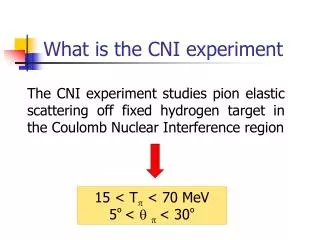
The CNI experiment investigates pion elastic scattering off a fixed hydrogen target, specifically within the Coulomb Nuclear Interference (CNI) region for incident pion momenta ranging from 15 to 70 MeV and scattering angles between 5° and 30°. Conducted by the CHAOS collaboration using the Canadian High Acceptance Orbital Spectrometer, the study employs innovative detection techniques for charged particles across a 360° range. It is performed at the TRIUMF facility in Vancouver and utilizes advanced experimental layouts for vertex reconstruction and momentum analysis.

E N D
What is the CNI experiment The CNI experiment studies pion elastic scattering off fixed hydrogen target in the Coulomb Nuclear Interference region 15 < T < 70 MeV 5º < < 30º
Who performs CNI CHAOS collaboration: (,2 ), p, DCX Canadian High Acceptance Orbital Spectrometer Detects chargeparticles within360º in-plane 7º out-of-plane
Where is CNI performed M13 low energy pion channel TRIUMF, Vancouver
Vertex reconstruction Empty target Hydrogen target
Experimental layout Drift wire chambers Beam counter MWPCs Hydrogen target E telescope / telescope Magnet yoke