Download
1 / 23
230 likes | 357 Vues
This study investigates the Internet's hierarchical routing structure, focusing on autonomous systems (AS) and the protocols they use, such as BGP. Through extensive measurements using Network Probes Daemon (NPD) across various sites, the research explores routing pathologies including persistent and temporary loops, erroneous routing, and anomalies in connectivity. It examines route stability, persistence, and changes in routes over time, shedding light on both the prevalence and symmetry of routes. The findings highlight the challenges in Internet routing, including infrastructure failures and the impact of routing issues on performance.

E N D
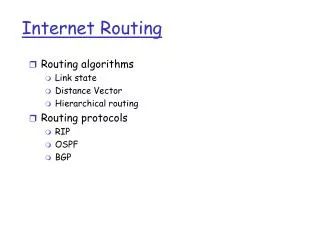
Internet Routing • Internet organized as a two level hierarchy • First level – autonomous systems (AS’s) • AS – region of network under a single administrative domain • AS’s run an intra-domain routing protocols • Link State, e.g., OSPF • Distance Vector, e.g., RIP • Between AS’s runs inter-domain routing protocols, e.g., Border Gateway Routing (BGP) • De facto standard today, BGP-4
End-to-End Routing Behavior in the Internet[Paxson ’97] • Idea: use end-to-end measurements to determine • Route pathologies • Route stability • Route symmetry
Methodology • Run Network Probes Daemon (NPD) on a large number of Internet sites
Methodology • Each NPD site periodically measure the route to another NPD site, by using traceroute • Two sets of experiments • D1 – measure each virtual path between two NPD’s with a interval of 1-2 days, Nov-Dec 1994 • D2 – measure each virtual path using a bimodal distribution inter-measurement interval, Nov-Dec 1995 • 60% with mean of 2 hours • 40% with mean of 2.75 days • Measurements in D2 were paired • Measure AB and then BA
Traceroute Example sky.cs.berkeley.edu whistler.cmcl.cs.cmu.edu
Methodology • Links traversed during D1 andD2
Methodology • Exponential sampling “memoryless” • Unbiased sampling – measures instantaneous signal with equal probability • PASTA principle - Poisson Arrivals See Time Averages - asymptotically, the proportion of our measurements that observe a given state is equal to the amount of time that the Internet spends in that state • Is data representative? • Argue that sampled AS’s are on half of the Internet routes • Confidence intervals 95% for probability that an event occurs
Limitations • Just a small subset of Internet paths • Just two points at a time • Difficult to say why something happened • 5% - 8% of time couldn’t connect to NPD’s Introduces bias toward underestimation of the prevalence of network problems
Routing Pathologies • Persistent routing loops • Temporary routing loops • Erroneous routing • Connectivity altered mid-stream • Temporary outages (> 30 sec)
Routing Loops & Erroneous Routing • Persistent routing loops (10 in D1 and 50 inD2) • Several hours long (e.g., > 10 hours) • Largest: 5 routers • All loops intra-domain • Transient routing loops (2 in D1 and 24 inD2) • Several seconds • Usually occur after outages • Erroneous routing (one in D1) • A route UKUSA goes through Israel • Question: Why do routing loops occur even today?
Route Changes • Connectivity change in mid-stream (10 in D1 and 155 inD2) • Route changes during measurements • Recovering bimodal: (1) 100’s msec to seconds; (2) order of minutes • Route fluttering • Rapid route oscillation
Problems with Fluttering • Path properties difficult to predict • This confuses RTT estimation in TCP, may trigger false retransmission timeouts • Packet reordering • TCP receiver generates DUPACK’s, may trigger spurious fast retransmits • These problems are bad only for a large scale flutter; for localized flutter is usually ok
Infrastructure Failures • NPD’s unreachable due to many hops (6 in D2) • Unreachable more than 30 hops • Path length not necessary correlated with distance • 1500 km end-to-end route of 3 hops • 3 km (MIT – Harvard) end-to-end route of 11 hops • Question: Does 3 hops actually mean 3 physical links? • Temporary outages • Multiple probes lost. Most likely due to: • Heavy congestions lasting 10’s of seconds • Temporary lost of connectivity
Distribution of Long Outages (> 30 sec) • Geometric distribution
Routing Stability • Prevalence: • “Given that we observed route r at the present, how likely are we to observe r again in the future?” • Steady state probability that a virtual path at an arbitrary point in time uses a particular route • Conclusion: In general Internet paths are strongly dominated by a single route • Where “dominated” means that we are likely to repeatedly observe that same route when measuring at random points in time • Persistence: • how long a route remains unchanged • Affects utility of storing state in routers • Conclusion: routing changes occur over a wide range of time scales, i.e., from minutes to days
Route Prevalence • I • The median value of the prevalence of the dominant route is 82% at host (router) granularity, at city granularity, and 100% at AS granularity
Route Symmetry • We confine ourselves to studying “major” asymmetries, in which the sequence of cities or AS's visited by the routes for the two directions of a virtual path differ. • 30% of the paths in D1 and 50% in D2 visited different cities • 30% of the paths in D2 visited different AS’s • Problems: • Break assumption that one-way latency is RTT/2
Summary of Paxson’s Findings • Pathologies doubled during 1995 • Asymmetries nearly doubled during 1995 • Paths heavily dominated by a single route • Over 2/3 of Internet paths are reasonable stable (> days). The other 1/3 varies over many time scales
Concluding remarks • [Paxson] Internet routing can have several problems due to loops, route fluttering, long outages. • [Savage] Internet routing protocols are not well-tuned for choosing performance optimal paths. • Where does this lead us to? • 1: Try to redesign a better protocol to fix problm • Will such an approach ever work? • 2: Use overlay networks to route around them [RON] • 3: Reliability is important, but is optimal performance needed? Probably not.