Rationalizing Denominators in Radicals
110 likes | 234 Vues
Rationalizing the denominator is a mathematical process used to eliminate radicals from the denominator of a fraction. This guide illustrates how to rationalize denominators in different types of radical expressions. By multiplying both the numerator and denominator by an expression equivalent to 1, we ensure that the value of the expression remains unchanged while removing the radical from the denominator. Through various examples, we demonstrate how to approach rationalizing square roots, cube roots, and fourth roots effectively.


Rationalizing Denominators in Radicals
E N D
Presentation Transcript
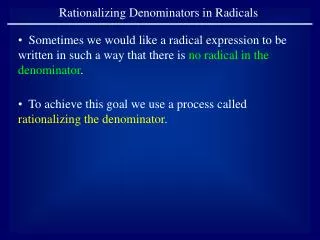
Rationalizing Denominators in Radicals • Sometimes we would like a radical expression to be written in such a way that there is no radical in the denominator. • To achieve this goal we use a process called rationalizing the denominator.
Multiply both numerator and denominator by • Example 1 Rationalize the denominator: We would like to eliminate the radical from the denominator.
Notice that the radical in the denominator has been eliminated. Note also that we multiplied by an expression equivalent to 1, so the value of the expression was not changed.
Example 2 Rationalize the denominator: We would like to eliminate the radical from the denominator. Since the radical in the denominator is a fourth root, we need a perfect fourth power under the radical.
Consider this method to determine the necessary radicand. Since there is one factor of 3 already … … three more factors of 3, would give a total of four, and thus a perfect fourth power.
Consider this method to determine the necessary radicand. Since there is one factor of 3 in the radicand already … … three more factors of 3, would give a total of four, and thus a perfect fourth power.
Example 3 Rationalize the denominator: We would like to eliminate the radical from the denominator. Since the radical in the denominator is a cube root, we need a perfect third power under the radical.
One factor of 5 already … … so two more factors of 5 are needed. Two factors of y already … … so one more factor of y is needed.
One factor of 5 already … … so two more factors of 5 are needed. Two factors of y already … … so one more factor of y is needed.
END OF PRESENTATION Click to rerun the slideshow.