Exploring Saturn: A Look at Its Rings, Atmosphere, and Internal Structure
Discover the wonders of Saturn, the second-largest planet in our Solar System. With its stunning rings spanning 200,000 km yet just 0.2 km thick, Saturn showcases icy particles and intriguing features like gaps and shepherding satellites. Despite receiving only 25% of the sunlight that Jupiter does, Saturn emits more heat, likely due to gravitational contraction and unique atmospheric processes. Delve into Saturn’s magnetic field, dynamic yellowish-tan clouds, and similarities to Jupiter, as we explore this magnificent "Ring World."

Exploring Saturn: A Look at Its Rings, Atmosphere, and Internal Structure
E N D
Presentation Transcript
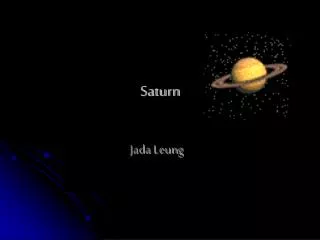
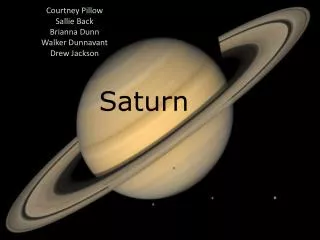
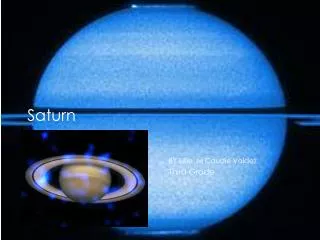
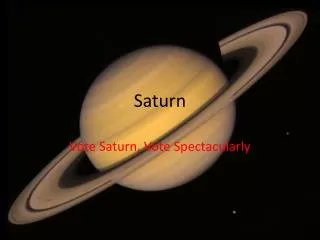
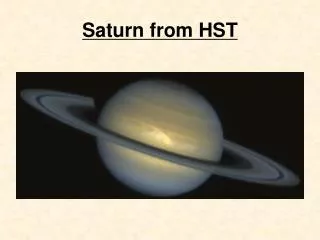
Saturn Highlights • Magnetic field about 2/3 of Earth’s • Atmosphere and interior structure similar to Jupiter • Yellowish-tan clouds and fewer dynamic storms • Rings are splendoriforous!
Sat. receives on 25% as much sunlight as Jup. Yet, Sat. emits 50% more than what it absorbs! Similar to Jup., but for same reason? No! Heat from gravitational contraction should now be gone, since Sat. is smaller Instead, He may be draining thru metallic H mantle to the core, thereby liberating heat In hotter Jup., He remains dissolved – no draining Consequence: He depleted in Sat. atm. – explains why He/H = 1/4 for Jup. but 1/7 for Sat. Internal Heat of Saturn
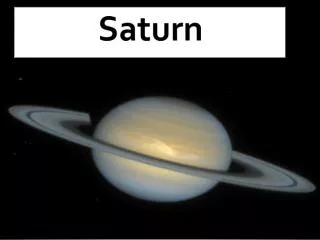
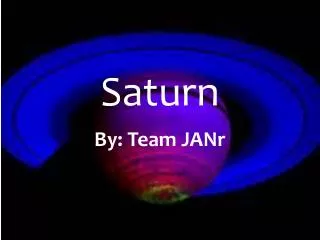
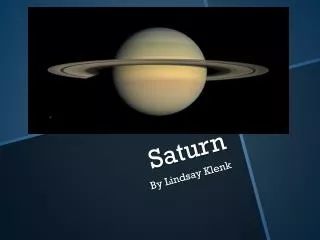
The Rings of Saturn • Rings are 200,000 km across, but less than 0.2 km thick! • Consist mostly of icy particles, ranging in size from 1 cm to 10 m • Rings reside inside the Roche Limit • Main features: • Gaps • Sharp edges • Spokes • Shepherding satellites