Thermodynamics
This review provides a comprehensive overview of thermodynamic principles, focusing on energy conservation, laws of thermodynamics, and the relationship between enthalpy and entropy. It discusses the first law of thermodynamics, internal energy, and the significance of heat and work in energy exchanges. The second law highlights spontaneous reactions and entropy as a measure of disorder, while the third law establishes the baseline for entropy at absolute zero. The review concludes with Gibbs free energy, illustrating its use in predicting reaction spontaneity and equilibrium.

Thermodynamics
E N D
Presentation Transcript
Thermodynamics Chapter 19 Brown-LeMay
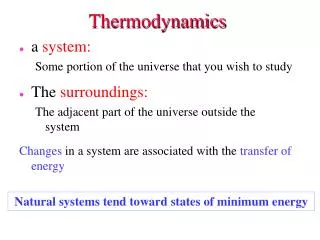
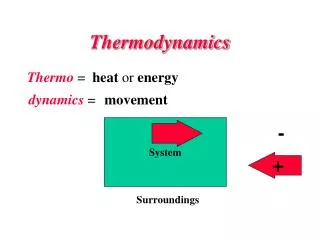
I. Review of Concepts • Thermodynamics – area dealing with energy and relationships • First Law of Thermo – law of conservation of energy - U = q + w the change in internal energy of a system equals q + w • Internal energy is a state function – one that is independent of the pathway (altitude- state function, miles traveled is not a state function
Concept review • Heat (q) is the energy that moves into or out of a system because of temperature differences between the system and the surroundings • Work (w) – energy exchange that results when a force (f) moves an object through a distance (d) w = f x d • Work done to the system is positive work done by the system is negative
Concept review • Work in a chemical system can de described by the pressure and change in volume of a system • W = -p v u = qp + w cons. pressure u = qp – p v • H is the reaction q at constant pressure H = qp
Delta H • More precisely H is the quantity u + pv • H = u + pv H = u + pv H = qp – pv + pv • H = qp • All U,P,V are state functions so H is also a state function • H = n H0f(products) - n H0f (reactants)
II. Entropy and the Second Law • Spontaneous reactions – are a physical or chemical change that occurs by themselves • When delta H is neg – exothermic the reaction tend to be spontaneous • Spontaneous reactions are non-reversible • When delta H is positive – endothermic the reaction may or may not be spontaneous
II. Entropy and the Second Law • Endothermic reactions are/not spontaneous because of the naturally tendency to ether move towards or away from a random state • Entropy S or S- is a measure of randomness or disorder of a system (J/K) state function (influenced by temp and pressure)
The Second Law • The entropy of a system and its surrounds always increases in a spontaneous process • s = s (final) – s (initial) • s+ = increase in disorder • s- = decrease in disorder • different from energy because it can be created
Second Law • Delta S = entropy created + q/T • Delta S > q/T spontaneous • Delta S = q/T equilibrium • For a process to be spontaneous at a given temperature, the change in entropy of the system is greater than the heat of they system divided by the absolute temperature
Second Law (spontaneous rxn) • Delta s > qp/T = Delta H/T = Delta H/T – Delta S < 0 H – T S <0 spontaneous H – T S >0 non-spontaneous H – T S =0 Equilibrium You can often look up Delta H and Delta S values form tables and determine if a reaction is spontaneous as written under certain conditions
The Third Law & Predicting Entropy Change • Third Law – a substance that is perfectly crystalline at 0 Kelvin has an entropy of zero – as the temp of a substance is raised disorder increases as it absorbs heat
Changes in Entropy • In general Entropy increases as * Liquids or solutions are formed from solids * Gases are formed from either solids or liquids * The number of molecules of gas increases during a chemical reaction * the temperature of a substance in increased.
Ludwig Boltzmann – developed a method to calculate entropies of substances based on the number of possible arrangements of the particles of a system • Standard Entropy – So – the entropy value for the standard state of the species (indicated by the subscript sign) • Gas – pure sub at 1 atm tempt 250C or 298 k – Solutions are one molar. • Calc So = Sum n So products - Sum n So reactants
Free Energy and Spontaneity • The Gibbs free energy of a substance combines its enthalpy and entropy into a single quantity that describes the total amount of energy available for use. • G = H – TS • At const temp G = H – T S • If G is neg(-) the rxn is spontaneous • If G is pos(+) the rxn non-spontaneous • If G is zero the rxn is at equilibrium