Overview of Scaling Methods for Particle Physics Data Analysis
This document presents an analysis of various scaling methods used to obtain C(E) values in particle physics experiments. The methods outlined include five distinct approaches based on horn-off and horn-on data, using energy cut-offs and Monte Carlo (MC) ratios. Additionally, multiple fitting methods are discussed, leveraging techniques from prior research while emphasizing regions without m+ contributions. The findings include predictions from the fitting results, aimed at enhancing data reliability by contrasting the expected versus actual results, particularly concerning decay candidates.

Overview of Scaling Methods for Particle Physics Data Analysis
E N D
Presentation Transcript
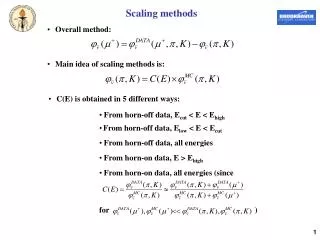
Scaling methods • Overall method: • Main idea of scaling methods is: • C(E) is obtained in 5 different ways: • From horn-off data, Ecut < E < Ehigh • From horn-off data, Elow < E < Ecut • From horn-off data, all energies • From horn-on data, E > Ehigh • From horn-on data, all energies (since • for )
n from m+, MC Scaling method 1: L010000 data/MC ratio, Ecut < E < Ehigh data Scaled MC, no m+ data/MC L010000 data-Scaled MC
n from m+, MC Scaling method 2: L010000 data/MC ratio, 4 < E < Ecut data Scaled MC, no m+ data/MC L010000 data-Scaled MC
n from m+, MC Scaling method 3: L010000 data/MC ratio, all E Pol 4th deg data Scaled MC, no m+ data/MC L010000 data-Scaled MC
n from m+, MC Scaling method 4: L010185 data/MC ratio, E > Ecut constant Pol 3rd deg data Scaled MC, no m+ data/MC L010185 data-Scaled MC
n from m+, MC Scaling method 5: L010185 data/MC ratio, all E’s Pol 4th deg data Scaled MC, no m+ data/MC L010185 data-Scaled MC
Fit methods • Used same procedure as Zarko & Rustem showed in Boston, i.e. Mega Fit such that: • Parameterize fluka p- yields. • 6 parameters to distort pt-xf p- distributions. • 2 parameters for kaons. • No Zbeam parameters, except for POT • Difference lies in that only regions with no m+ contributions are fit. Three separate fits were performed: • le010z000i (all E) & le010z185i (with E>Ecut) • le010z185i (with E>Ecut) • le010z000i (all E)
Fit 1: le010z185i (E>Ecut) & le010z000i (all E) le010z185i le010z000i
Fit 2: le010z185i (E>Ecut) le010z185i
Fit 3: le010z000i (all E) le010z000i
n from m+, MC Fit 1: le010z185i (E>Ecut) & le010z000i (all E) data Fit MC, no m+ MC (no m+) Fit MC (no m+) data-Fit MC
n from m+, MC Fit 2: le010z185i (E>Ecut) data Fit MC, no m+ MC (no m+) Fit MC (no m+) data-Fit MC
n from m+, MC Fit 3: le010z000i (all E) MC (no m+) Fit MC (no m+) data Fit MC, no m+ data-Fit MC
n from m+ decay candidates n from m+ decay candidates Summary of Results Expected to be negative Should be ~0 if data/MC from horn-off is trust worthy in this region Should be 0 by construction Should be real nubars from m+ all methods (except fit method 2) all methods