Understanding Periodic Functions and Trigonometry: Key Concepts and Objectives
70 likes | 216 Vues
This lesson focuses on the significance of periodic functions and their applications in trigonometry. Students will learn to determine exact values for trigonometric functions both with and without calculators. The unit objectives include writing and graphing trigonometric functions, finding amplitude, period, maximums, minimums, and phase shifts for periodic functions, and modeling real-world problems using these concepts. By the end of the lesson, students will be able to identify cycles, periods, and amplitudes of various periodic functions, enhancing their understanding of the patterns in mathematics.


Understanding Periodic Functions and Trigonometry: Key Concepts and Objectives
E N D
Presentation Transcript
Periodic Functions and Trigonometry Unit Objectives: Determine exact values for trigonometric functions: with and without a calculator Write and graph trigonometric functions Find amplitude, period, maximums, minimums and phase shifts for periodic functions Model problems using trigonometric functions Today’s Objective: I can find a cycle, period and amplitude of periodic function.
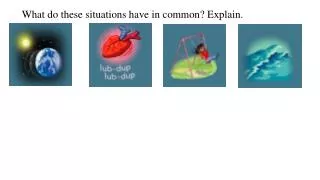
What do these situations have in common? Explain Periodic Function: A function that repeats a pattern of outputs (y-values) at regular intervals Cycle: One complete pattern Period: Horizontal length of a cycle – distance along x-axis
to One cycle: or to Period: One cycle to to Period:
Determine whether function is periodic. If so identify one cycle and determine the period. Not Periodic One cycle Period: to One cycle Period: to Not Periodic
Maximum Midline Minimum amp. Midline: Horizontal line midway between maximum and minimum values (maximum + minimum) Half the difference between maximum and minimum Amplitude: amp. (max. – min.)
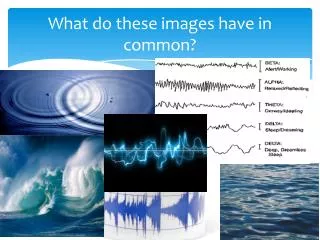
One cycle: Period: Midline: Amplitude: to What is the period, the amplitude and the equation of the midline for each sound wave displayed below. One cycle: Period: Midline: Amplitude: to p.832: 7-18, 21-25