Download
1 / 21
210 likes | 323 Vues
This session covers essential strategies for responding to security incidents, particularly breaches under HIPAA regulations. Led by Chris Apgar, CISSP, the discussion emphasizes the establishment of a security incident response team, investigating breaches through forensic analysis, and mitigating damages effectively. Attendees will learn about HIPAA requirements, importance of documentation, and best practices for incident management. Proactive measures, timely actions, and adherence to regulatory requirements are critical to minimizing legal and reputational risks.

E N D
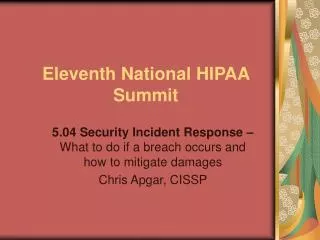
Eleventh National HIPAA Summit 5.04 Security Incident Response – What to do if a breach occurs and how to mitigate damages Chris Apgar, CISSP
Overview • Background • Establishing a security incident response team • Forensics or how to investigate a breach • Follow up or how to mitigate damages • Summary & resources
Background • HIPAA requirements • Establishing policies and procedures • Importance of documentation • Mitigation of legal and regulatory risks • Sound security practices
Establishing a Security Incident Response Team • What is a security response team? • Designing the program • Corporate buy in • Determining size of team based on policy and process requirements • Establishing the team
Establishing a Security Incident Response Team • Establishing a chain of command • Supporting policies and procedures • Designating a team lead • Responsibilities of the team and team lead • Training the team
Establishing a Security Incident Response Team • Establishing a support structure in the organization • Mapping out process and external resources • What external resources may be needed? • Relation to disaster recovery plan
Forensics or How to Investigate a Breach • Stop any further breach • Solving the “crime” • Importance of creating an evidence trail • Importance of creating un-impeachable evidence
Forensics or How to Investigate a Breach • Investigating the breach • Duties of the incident response team • Establishing a command center • Determining type of breach • Determining if truly a breach or a malfunction of software/hardware
Forensics or How to Investigate a Breach • Tracing the breach to its source • Internal versus external breach – hacker versus employee • Actions to be taken based on source of breach • Regulatory requirements in some states
Forensics or How to Investigate a Breach • A word about investigations • Treat a breach as if you were a detective • If criminal activity is present following proper forensic procedures is extremely important • When is it necessary to call in the police, FBI, etc.?
Forensics or How to Investigate a Breach • Use of external organizations to conduct investigations • Advantages of external resources to smaller organizations • Use of external resources does not mean it replaces at least a small incident response team • Best to contract in advance of any incident
Follow Up or How to Mitigate Damages • A word about mitigating damages • Importance of proper backup and recovery processes • Don’t forget proper forensics – keep a copy of the data in question before restoring safeguards, data, etc. • Coordinate with incident response team
Follow Up or How to Mitigate Damages • Fast action results in lower mitigation requirements • Assess damage to data, hardware, software • Coordinate with appropriate organizational representatives but keep the list short • Determine if privacy breach also occurred
Follow Up or How to Mitigate Damages • Determine whether to notify members or patients of any privacy breach • Be aware of state reporting requirements (especially California) • Avoiding adverse publicity • Proactively responding if adverse publicity occurs
Follow Up or How to Mitigate Damages • Limiting litigation or legal risk • Limiting regulatory risk • Why or why not report incidents to the authorities • Internal versus external exposure
Follow Up or How to Mitigate Damages • Internal versus external perpetrator • Involving Human Resources • Sanctions – consistency a must • Determining the audience – who should I tell? • Steps to limit future threat of similar nature
Follow Up or How to Mitigate Damages • No requirement to report breach to OCR or CMS but state laws may require reporting • What if CMS or OCR investigates? • Importance of policies and procedures • Check your contracts – do they require any specific reporting and when • Returning to normal
Summary • Establish incident response team before incidents occur • The importance of forensics • Importance of consistency and limiting exposure • Fast reaction limits damages and mitigation costs • Beware of regulatory, legal and public exposure
References • NIST Special Publication 800-61: http://csrc.nist.gov/publications/nistpubs/800-61/sp800-61.pdf • SANS: http://www.sans.org • ISSA: http://www.issa.org • WEDI: http://www.wedi.org/snip
References • Handbook for Computer Security Incident Response Teams (Carnegie Mellon): http://www.sei.cmu.edu/publications/documents/03.reports/03hb002.html • FCC Computer Security Incident Response Guide: http://csrc.nist.gov/fasp/FASPDocs/incident-response/Incident-Response-Guide.pdf • ISS Computer Security Incident Response Planning: http://documents.iss.net/whitepapers/csirplanning.pdf
Chris Apgar, CISSP President Apgar & Associates, LLC 10730 SW 62nd Place Portland, OR 97219 (503) 977-9432 (voice) (503) 816-8555 (mobile) Capgar@easystreet.com http://www.apgarandassoc.com Q&A