Download
1 / 17
190 likes | 316 Vues
This guide provides a thorough overview of simplifying and comparing fractions. A fraction is said to be simplified when its numerator and denominator have a greatest common factor (GCF) of 1. To simplify fractions, divide both the numerator and denominator by their GCF. For comparing fractions, use a number line to graph them, or find a common denominator by calculating the least common multiple (LCM). Additionally, the heart method offers a visual approach for comparing fractions effectively.

E N D
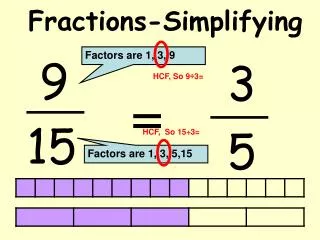
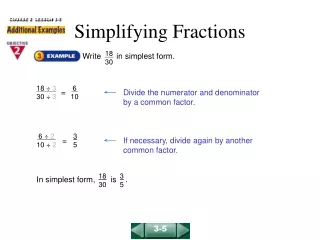
Simplifying Fractions • A fraction is “simplified” when its numerator and denominator have a GCF of 1
To Simplify Fractions • Divide the numerator and denominator by the GCF
Example Simplify: • What is the GCF of 12 and 20? • 4
Simplify • What is the GCF between 4 and 10? • 2
Simplifying With Variables • Divide numbers by GCF • List the variables out • Cancel out the variables
Simplify: 1 3
Comparing Fractions Using a Number Line • Graph the fractions on the number line • The number to the left is the smaller number
Comparing Fractions • Get the same denominator (LCD) • Find the LCM of the denominators • Make an Equivalent fraction • Multiply each the fraction (numerator and denominator) by number to make the LCM • Once the denominators are the same compare the numerators
Heart Method to Compare Fractions • Multiply the diagonals, bring down and compare the products
Homework Page 236 (16-42) even