Smaller Bodies in the Solar System
160 likes | 316 Vues
This insightful overview delves into the smaller celestial bodies in our solar system, highlighting the Asteroid Belt, located between Mars and Jupiter, which contains major dwarfs like Ceres and Vesta. It contrasts this with the Kuiper Belt's frozen volatiles beyond Neptune. Discover the fascinating history of these discoveries, including the observations that led to finding Ceres and understanding comets and meteoroids. Learn about the differences between meteoroids, meteors, and meteorites, and uncover theories about the outer solar system's formation.


Smaller Bodies in the Solar System
E N D
Presentation Transcript
Smaller Bodies in the Solar System By Kynsey Creel http://www.agdesktop.com/wallpapers\space\stars\star-0005.jpg
Topics • Asteriod Belt • Pictures • History of Discovery • Kuiper Belt • Theories • Comets • Meteoroids • Meteors • Merteorites • The Difference Between the three http://www.astronomy.com/asy/objects/images/hubble-galaxy-silhouettejpg.jpg
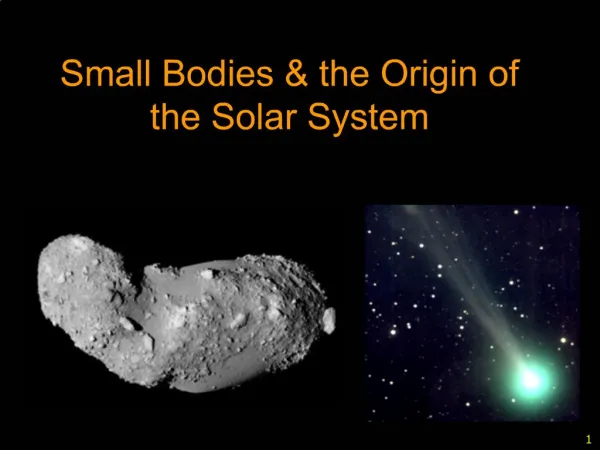
The Asteroid Belt • The Main Belt • Located roughly between Mars and Jupiter • Comprised of asteroids and minor planets • Half the mass in 4 bodies • Ceres (smallest Dwarf Planet) 4 Vesta, 2 Pallas, 10 Hygiea • Diameter more than 400 m • Smallest bodies range down to dust particles • Asteroids can be classified by spectra • carbonaceous (C-type), Silicate (S-type), Metal-rich (M-type)
http://upload.wikimedia.org/wikipedia/commons/f/f3/InnerSolarSystem-en.pnghttp://upload.wikimedia.org/wikipedia/commons/f/f3/InnerSolarSystem-en.png
http://2.bp.blogspot.com/__e2VLp6gwyk/SUaIeuNzilI/AAAAAAAABm8/wu2sJGWesPE/s320/275px-PallasHST2007.jpghttp://2.bp.blogspot.com/__e2VLp6gwyk/SUaIeuNzilI/AAAAAAAABm8/wu2sJGWesPE/s320/275px-PallasHST2007.jpg http://upload.wikimedia.org/wikipedia/commons/f/fc/Ceres_optimized.jpg 2 Pallas Ceres 10 Hygiea 4 Vesta http://www.johnstonsarchive.net/astro/gallery/Vesta.jpg http://4.bp.blogspot.com/_5PcuUnvp1a4/SfzS3GYRNyI/AAAAAAAAAW0/warXj5RyD4w/s400/hygiea.jpg
History of Observations • In 1800 astronomer Franz Xaver von Zach assembled the Celestial Police • Searching for “the missing planet” between mars and Jupiter • Based off Predictions byJohann Daniel TitiusvonWittenburg • In 1801 Giuseppe Piazzi discovered the planet “Ceres” • William Herschel categorized Ceres and the other dwarf planets as asteroids , “star like” Giuseppe Piazzi http://upload.wikimedia.org/wikipedia/commons/9/92/Giuseppe_Piazzi.jpg
Kuiper Belt • Lays outside Neptune’s orbit • Similar to Asteroid belt except much larger • Comprised of frozen volatiles • Methane, ammonia, water (ice) • Pluto, Haumea, Makemake • Discovered in 1992 after the discovery of Pluto (might not be alone)
http://upload.wikimedia.org/wikipedia/commons/8/81/Outersolarsystem_objectpositions_labels_comp.pnghttp://upload.wikimedia.org/wikipedia/commons/8/81/Outersolarsystem_objectpositions_labels_comp.png
http://upload.wikimedia.org/wikipedia/commons/0/0b/GerardKuiper.jpghttp://upload.wikimedia.org/wikipedia/commons/0/0b/GerardKuiper.jpg History and Theories • Fredrick Leonard: First Astronomer to suggest outer Neptunian bodies • Kenneth Edgeworth: hypothesized that the region beyond Neptune was too widely spaced for Planets • Gerard Kuiper: suggested a “disk” outside Neptune Gerard Kuiper
Comets • Small Solar System bodies that orbit the sun • Orbital periods take up to hundreds of thousands of years • Short period comets originate in the Kuiper Belt • Thrown out of the belt by gravitational pulls • Coma (fuzzy “atmosphere”) and a tail • Ice, dust, rocky particles • Range from a few km- 10 km across • 3,648 known comets (increasing)
http://en.wikipedia.org/wiki/File:Comet-Hale-Bopp-29-03-1997_hires_adj.jpghttp://en.wikipedia.org/wiki/File:Comet-Hale-Bopp-29-03-1997_hires_adj.jpg http://en.wikipedia.org/wiki/File:060227comet.jpg http://en.wikipedia.org/wiki/File:17pHolmes_071104_eder_vga.jpg http://en.wikipedia.org/wiki/File:Jupiter_showing_SL9_impact_sites.jpg
Meteoroids/Meteors/Meteorites • Meteoroids- sand (micrometeoroids) to boulder size, part of meteor showers • Orbit the sun at various velocities • Collide with Earth if in retrograde motion at speeds ~70km/s • Meteoroids that enter earth’s atmosphere are meteors • Meteors that reach Earth’s surface are meteorites
Summary Asteroid Belt/Main Belt Mars and Jupiter Discovery by Guiseppe Piazzi Kuiper Belt theories behind it (Gerard Kuiper) Comets Meteoroids/Meteors/Meteorites http://jzholloway.files.wordpress.com/2008/07/jupitermilkyway070108-sb-1b.jpg
The End Complements to wiki