Comprehensive Overview of Total Quality Management (TQM) and Its Key Contributors
180 likes | 337 Vues
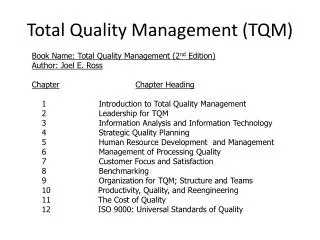
Total Quality Management (TQM) is a market-driven strategy prioritizing customer satisfaction through continuous improvement and fact-based decision-making. It engages employees at all levels, along with customers and suppliers, to enhance quality systems and performance. Key figures in TQM include Edward Deming, known for his philosophy focusing on quality, and other pioneers like Kaoru Ishikawa and Philip Crosby. TQM aims to eliminate waste, foster teamwork, and create an environment of learning and collaboration, challenging traditional notions of quality control.


Comprehensive Overview of Total Quality Management (TQM) and Its Key Contributors
E N D
Presentation Transcript
Quality Strategy Team work involving customers & suppliers TQM Quality Systems, Problem Solving Quality Assurance Statistical Methods, Process Performance Quality Control Inspection Error Detection, Rectification
TQM • A comprehensive strategy that goes beyond Quality Control and Quality Assurance • Is a market driven strategy – central focus is on the customers • Involves - employees at all levels, customers and suppliers - continuous improvements - decisions based on facts
TQM • Leading contributors to TQM movement - Kaoru Ishikawa (CED) - Philip Crosby (Zero Defect) - Edward Deming (Deming Cycle) - Joseph Juran (QC - Teams) - Shigeo Shingo & Taiichi Ohno (JIT) - Masaoki Imai (Kaizen) - Taguchi (Robust Design)
Edward Deming’s Philosophy Obsession with Quality Genuine Team Work Scientific Approach
Edward Deming • Adopt the new philosophy and demonstrate the commitment • End practice of awarding business on price tag alone • Institute training and retraining • Drive out fear • Eliminate slogans, exhortations • Eliminate numerical quotas • Remove barriers to pride of workmanship
Edward Deming (contd.) • Some obstacles: - Neglect of long-range planning, emphasis on short-term profits - Automation, gadgets will transform industry - Search for examples - Our problems are different - False starts - Blaming workforce for problems
Phil Crosby • Quality has been regarded as a technical function – not a management function – hence needs to be presented to management in terms it can understand • Mistakes are caused by two factors - Lack of knowledge - Lack of attention (attitude problem)
Phil Crosby (contd.) • Management Function: COQ = POC + PONC • POC = what is necessary to spend to make things come out right (3 to 4 % of sales) • PONC = expenses incurred in doing things wrong (20 to 25 % of sales)
Phil Crosby (contd.) • Mistakes are caused by two factors - Lack of knowledge - Lack of attention (attitude problem) • ZD, DIRFT
Joseph Juran • There are non-uniformities and associated beliefs in uniqueness inherent in any company - multiple functions - multiple levels - multiple product lines • Serious obstacles to Unity of Direction • Need to find a universal thought process which fits all functions, all levels and all product lines
Deming • Create constancy of purpose - invest in research - invest in training and education - continual improvement - invest in maintenance • Adopt the new philosophy and demonstrate the commitment • Cease dependence on mass inspection
Deming (contd.) • End practice of awarding business on price tag alone • Institute training and retraining • Institute leadership • Drive out fear • Breakdown barriers between staff areas • Eliminate slogans, exhortations • Eliminate numerical quotas
Deming (contd.) • Remove barriers to pride of workmanship • Institute a vigorous programme of education • Take action to accomplish the transformation Plan Do Act Check
Deming (contd.) • Some obstacles: - Neglect of long-range planning, emphasis on short-term profits - Automation, gadgets will transform industry - Search for examples - Our problems are different - False starts - Blaming workforce for problems