Understanding Trade Discounts and Net Prices in Pricing Models
This guide explains the relationship between list prices, trade discounts, and net prices using a formulaic approach. By examining the calculation of trade discounts as a percentage of list prices, we clarify how to arrive at net prices through specific examples. For instance, applying a 30% trade discount to a list price of $100 yields a net price of $70. This systematic breakdown provides clarity on pricing structures for various financial contexts and can aid businesses in their pricing strategies.

Understanding Trade Discounts and Net Prices in Pricing Models
E N D
Presentation Transcript
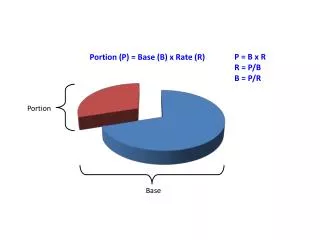
P = B x R R = P/B B = P/R Portion Base
Portion (P) = Base (B) x Rate (R) Trade Discount $ = List Price $ x Discount % $30 = $100 x .30 Net Price $ = List Price $ - Trade Discount $ $70 = $100 - $30 Net Price $/1 - Discount % = List Price $ $70/.70 = $100 Trade Discount $ List Price $ Net Price $