Metamorphic Rocks
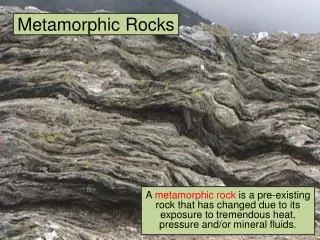
Metamorphic rocks form from existing rocks—sedimentary or igneous—under heat, pressure, or both through a process known as metamorphism. Parent rocks undergo significant changes, including recrystallization, where minerals rearrange and bond anew. Metamorphism can occur on both large and small scales, influenced by the type of parent rock, temperature, and pressure. Foliated rocks display a distinct banding of minerals, while non-foliated rocks are composed predominantly of a single mineral type. This natural process highlights the dynamic nature of Earth's geology.

Metamorphic Rocks
E N D
Presentation Transcript
Rock Formation • Sedimentary Rocks and Igneous rocks form from: • Other Rocks • Metamorphic Rocks form as existing rocks change.
Popcorn • How do you make popcorn? • Add heat to a kernal. • It pops and becomes a fluffy snack.
Metamorphism • The process of changing an existing rock by heat or pressure, or both.
Parent Rocks • The original sedimentary or igneous rock is called a parent rock.
Undergoing Change • Pressure can cause a rock’s minerals to flatten out in one direction. • The rock does NOT melt during this process. • If the rock did melt, what kind of rock would we now have?
Recrystallization • Crystals form from minerals. • Heat and/or pressure break the bonds of those atoms. • The bonds then can reform in a new way.
Changes occur over large and small areas. • Changes that occur depend on: • Type of Parent Rock • Temperature • Pressure
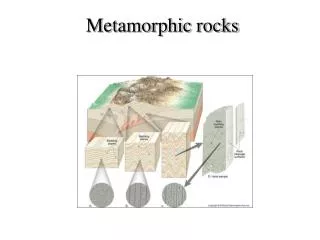
Changes occur over large and small areas. • For metamorphic change to occur over large areas there must be: • High Pressure • High Temperature • When only one of these is present, changes tend to occur over smaller areas. Large Areas Small Areas
Metamorphism Over Large Areas • Large blocks of rocks are pushing together. • Rocks are: • Buried • Pushed together • Heated • Bent • Deeper the rock, the greater the metamorphism
Metamorphism Over Small Areas Using Heat • Magma can push up through cracks in the rocks. • Lava can cover rocks on the earth’s surface. • Mainly due to high temperature, not pressure.
Metamorphism Over Small Areas Using Pressure • Rocks move and grind past each other during tectonic plate movement. • This creates a great amount of pressure.
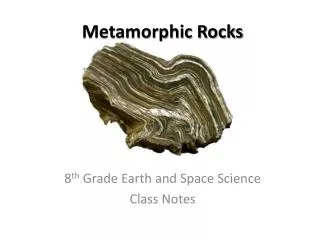
Foliation • Found in metamorphic rocks • Arrangement of minerals in flat or wavy parallel bands.
Foliated Rocks • Commonly found in rocks produced by metamorphic change over large areas. • Found in rocks that are composed of more than one mineral
Non-Foliated Rocks • Made of mainly one type of mineral. • Different minerals cannot separate and line up. • Has not been subjected to high pressure.