Exploring Neutron Interferometry: Quantum Properties, Decoherence, and Contextuality
This work delves into the foundational principles of neutron interferometry, highlighting the particle-wave duality of neutrons and their manipulation as quantum objects. It examines quantum state preparation and measurement techniques, along with the effects of magnetic noise on coherence. The study also discusses topological phases and the Kochen-Specker phenomenon, illustrating the contextual nature of quantum states. Experimental results from the S18 neutron interferometer at ILL, Grenoble, are presented, emphasizing the interplay between dynamics, geometric phases, and quantum contextuality in our understanding of quantum mechanics.

Exploring Neutron Interferometry: Quantum Properties, Decoherence, and Contextuality
E N D
Presentation Transcript
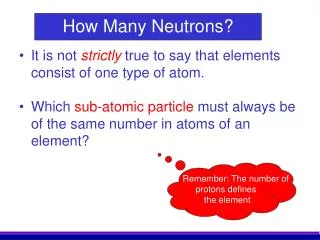
Neutrons as Manipulable Quantum Objects Helmut Rauch Atominstitut der Österreichischen Universitäten, Wien Particle-Wave Properties Basics of Neutron Interferometry Quantum State Preparation and Measurement Magnetic Noise Dephasing and Decoherencing Topological Phases Quantum Contextuality Kochen-Specker Phenomenon
The Neutron Particle Properties Wave Properties CONNECTION de Broglie Schrödinger & boundary conditions For thermal neutrons = 1.8 Å, 2200 m/s
Quantum skier Interferometer experiment
Wave packet in ordinary and momentum space Spatial distribution Non-classical state Coherent state Momentum distribution
Different quantum states Non-classical state (Schrödinger cat-like state) Coherent state
State presentations Schrödinger Equation: Partial waves fill the whole space Wave Function (Eigenvalue solution in free space): and others (Wigner function etc.) Momentum distribution: Spatial distribution: Coherence Function: Stationary situation:
D1 D2 Wave Packet Structure M.Baron, H.Rauch, M.Suda, J.Opt.B5 (2003) S341
Spinor Symmetry n Theory: H.J.Bernstein, Phys.Rev.Lett. 18(1967)1102, Y.Aharonov, L.Susskind, Phys.Rev. 158(1967)1237 Experiment:H.Rauch, A.Zeilinger, G.Badurek, A.Wilfing, W.Bauspiess, U.Bonse, Phys.Lett. 54A(1975)425 S.A.Werner, R.Colella, A.W.Overhauser, C.F.Eagen, Phys.Rev.Lett. 35(1975)1053 A.G.Klein, G.I.Opat, Phys.Rev. D11(1976)523 E.Klempt, Phys.Rev. D13(1975)3125 M.E.Stoll, E.K.Wolff, M.Mehring, Phys.Rev. A17(1978)1561
Topological Phase Theory: S.Pancharatnam, Proc.Ind.Acad.Sci. A44(1956)247 M.V.Berry, Proc.Roy.Soc.London, A392(1984)415 J.Anandan,Nature360(1992)307; R.Bhandari,Phys.Rep.281(1977)1 ........... dynamical phase ... geometric phase Experiment.:A.G.Wagh, V.C.Rakhecha, J.Summhammer, G.Badurek, H.Weinfurter, B.E.Allman, H.Kaiser, K.Hamacher, D.L.Jacobson, S.A.Werner, Phys.Rev.Lett. 78(1997)755
Geometric Phase Berry Phase (adiabatic & cyclic evolution) [ Berry; Proc.R.S.Lond. A 392, 45 (1984)] Ω (for 2-level systems) Non-adiabatic evolution Non-adiabatic & non-cyclic evolution [Aharonov & Anandan, PRL 58, 1593 (1987) [Samuel & Bhandari, PRL 60, 2339 (1988)]
Non-adiabatic & Non-cyclic Phase Results: Cancelling dynamical phase, if S. Filipp, Y. Hasegawa, R. Loidl and H. Rauch, Phys.Rev. A72 (2005) 021602
Future Prospects: Decoherence [De Chiara and Palma, PRL 91, 090404 (2003)] Variance of geometric phase (sg2) tends to 0 for increasing time of evolution in magnetic field.
Dephasing at low order Magnetic noise fields M.Baron, H.Rauch, M.Suda (in progress)
Dephasing at high order M.Baron, H.Rauch, M.Suda,J.Opt.B5 (2003) S244
Magnetic Noise Field Contrast reduction Momentum smearing Theory C = C0exp[-(μΔBDeff/ћv)2/2]
EPR - Experiment A. Einstein, B. Podolsky and N. Rosen, Phys. Rev. 47 (1935) 777.
Two-particle vs. two-space entanglement -2 < S < 2 S = E(α1,χ1) - E(α1,χ2) + E(α2,χ1) + E(α2,χ2) ==>> (Non-)Contextuality (In)Dependent Results for commuting Observables
Contextuality Experiment .Y.Hasegawa, R.Loidl, G.Badurek, M.Baron, H.Rauch, Nature 425 (2003) 45 and Phys.Rev.Lett.97 (2006) 230401
Manipulation of two-subspaces (a) Path (b) Spin
Result: S = 2.051 ± 0.019 Theory: SMax = 2.82 Classical correlation: (hidden variables) -2 < S´ < 2 Contextuality Results
Kochen-Specker Theory S. Kochen, E.P. Specker, J. Math. Mech. 17 (1967) 59
Results = -0.610(8) = -0.667(8) = -0.861(10) Y. Hasegawa, R. Loidl, G. Badurek, M. Baron, H. Rauch, Phys.Rev.Lett. 97 (2006) 230401
Results and contradiction Ideally Eexp = +1 Emsr = -1 } Ex = -0.610 Enc = ExEy= +0.407 Ey = -0.667 Emeasured = -0.861 perfect contradiction Y. Hasegawa, R. Loidl, G. Badurek, M. Baron, H. Rauch, Phys.Rev.Lett. 97 (2006) 230401
Kochen-Specker phenomenon Cnon-contextual = Cclassic = 2 Ccontextual = Cquantum = 4 Cexperimental = 3.138(15) Y.Hasegawa, R.Loidl, G. Badurek, M.Baron, H.Rauch, PRL 97 (2006) 23040 A cartoon-like representation of quantum contextuality. The colour of a skier‘s jacket (the spinor-property in our experiment) is undetermined, represented by a superposition before other mesurements. After a ‘measurement‘ on the colour of his trousers (a measurement on the path in our experiment), his jacket automatically gets its own colours (the direction of spin is determined accordingly), depending on what was measued, e.g., blue- or orange-colours. Basically no correlation between the colours of jacket and trousers is expected!