Friction
This review explores the fundamental principles of friction and forces in two dimensions, grounded in Newton's laws of motion. It explains the nature of forces, including the concepts of static and kinetic friction. Friction, now understood as a result of electromagnetic interactions rather than mere surface roughness, plays a crucial role in motion. The text provides formulas to calculate frictional forces and coefficients of friction (CoF) experimentally. It also includes practical lab problems to illustrate how to determine CoF and apply it in real-world scenarios.

Friction
E N D
Presentation Transcript
Friction And Forces in Two Dimensions
Review • A force is a push or pull. • Newton’s 3 Laws of Motion: • Objects resist changes in velocity unless acted upon by a net force. • The magnitude of an object’s acceleration depends on the net force and inversely on the object’s mass. • a = Fnet / m • For every force there is an equal and opposite counter-force.
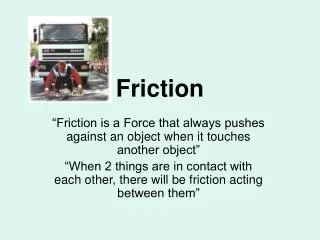
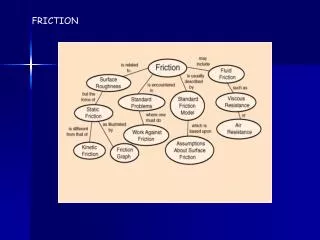
Friction • A force that opposes motion. • It was once thought that friction was caused by surface roughness. • In this model, microscopic nooks and bumps on the surface of an object lock and slip against similar features on another surface. • It is now known that this model is incorrect. • Friction is caused by brief electromagnetic interactions between charged particles in two surfaces.
Friction • Two important types of friction: • Static friction • Prevents motion from beginning • Kinetic friction • Prevents motion from continuing • Static friction is usu. stronger than kinetic friction. • This is why, when you’re pushing a heavy object across the floor, it’s harder to start it moving than it is to keep it moving.
Friction • Ff = FN • Ff = Friction (N) • = Coefficient of friction (no units) • FN = Normal force = mg cos • Coefficient of friction • Unique for every pair of substances and set of conditions. • Different CoF for static and kinetic friction.
Coefficient of Friction • CoF must be determined experimentally for any pair of surfaces. • = Ff / FN
Sample Problem • The coefficient of static friction between two blocks of wood is 0.500. What applied force is necessary to start a 250.-kg wooden box sliding along a horizontal wooden surface? • Fa must be equal to or greater than Ff,static. • Ff = FN • FN = Fw = mg • FN = (250. kg)(9.81 m/s2) • FN = 2450 N • Ff = (0.500)(2450 N) • Ff = 1230 N
Sample Problem 2 • A box with a mass of 40.0 kg requires an applied force of 250. N to keep it moving at a constant speed along a horizontal surface. What is the CoF between the box and the floor? • Ff = FN • Ff = mg • (250. N) = (40.0 kg)(9.81 m/s2) • (250. N) = (392 N) • = 0.638
In lab today • We will calculate the coefficient of friction between a shoe and the surface of a ramp. • You will volunteer the use of your shoes! • Place the shoes on a ramp. • Incline the ramp until the shoe begins to slide. • Measure the angle at which the shoe begins to slide. • Calculate the coefficient of friction using some simplifying math. • Repeat the procedure but first wet the shoe’s sole and the board.