Download
1 / 11
110 likes | 232 Vues
This document explores the deployment of wind turbines in Sweden, particularly focusing on their impacts on radio systems as studied by Stefan Mattsson at the Swedish Telecom Agency (PTS). The analysis highlights the potential disturbances to fixed systems like radar, radio relay, and broadcasting due to turbine obstructions and reflections. It delves into the responsibilities of the Swedish agency in ensuring coordination between wind turbine operators and radio system providers, as well as the importance of establishing protective exclusion zones for radio services.

E N D
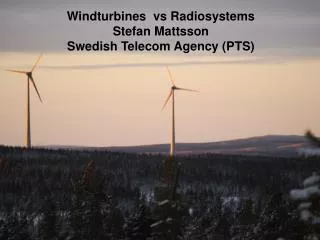
Windturbines vs RadiosystemsStefan MattssonSwedish Telecom Agency (PTS)
Content • Deployment • Impact • Protection • Responsibility • Web-site Vindlov • Permission process • FS-deployment in the surroundings to Onsala
Deployment of the wind • Sweden (2007) : 1 % of the country’s net electricity consumption • Corresponds to 1.4 TWh • Political decision (2002): • Production of 30 TWh prior to 2020 • Germany: 7,5 % (Source: GWEC, Global Wind Energy Council) • Spain: 11 %
Impact on radiosystems • Conducted studies confirms that fixed systems like Radar-, RadioRelay, Brodcasting-systems and RAS may experience disturbances due to obstruction and/or reflection caused by turbines. • In the case of Radars, shadowing and/or reflexions is the main problem when considering off-shore windturbines vs coastal surveillance radars. • The potential for these disturbances depends on the size of the turbine, material, location in relation to the ”victim” etc • For RAS, even EMC caused by the generator may cause disturbance in case the separation distance is not sufficiently large.
Protection • Exclusion zone around the RAS-site may provide sufficient protection if the zone is large enough. • Guidance on this zone, given by international recommendation(s), would be useful?
Responsibility of the Swedish agency • Provide, to the operator of wind turbines, a list of potentially concerned operators of radiosystems in a certain geographical area. • The intention with this procedur is to establish a ”marriage” between concerned operators with the objective to create a fruitful environment for coordination. • It should be noted that the agency is not responsible for the licensing of turbines. This issue is handled by the local authorities. • The agency is responsible for the protection of radio services only.
Web-site Vindlov (www.vindlov.se) - Swedish Energy Agency responsible for this site developed in cooperation with 20 authorities (incl the telecom agency) • - The objective is to provide information covering all aspects of the complicated process of licensing
Onshore Offshore Mini turbine 1 piece, < 20m, rotor ø < 3m Internal waters All internal bodies of water Farm turbine* 1 piece, 20-50 m, rotor ø > 3m Territorial sea Sweden’s Economic Zone Wind park – M 1 piece > 50 m OR≥ 2 pieces ≤ 150 m Wind park – L ≥ 2 pieces > 150 m OR ≥ 7 pieces > 120 m Permission/licensing process-Classification of wind turbines * incl. building mounted turbines
Onshore Offshore Mini Int. waters Farm Terr. Sea Park - M Park - L Permission/licensing process - guiding legislation & requirements EC/FMHa, CS Act Environmental permit, water activity permit & municipal grant (veto) P&B Act No permit required P&B Act Building permit SEZ Act, CS Act Government permit P&B Act, EC/FMHa, code C 40.100 Building permit & notification acc. Environmental Code Building notification All classes except for Mini turbines and Territorial sea! EC/FMHa, code B 40.90 and B 40.95 Environmental permit &municipal grant
Windfarm in the northern part of Sweden • 1 101 # of turbines • 2 500 – 4 000 MW total power • 8 – 12 TWh energy/year