Population Dynamics of the Northern Spotted Owl
Population Dynamics of the Northern Spotted Owl. Reasons for Listing, Current Status, and Recovery Strategy May 8, 2014. Northern Spotted Owl. Listed as threatened in 1990 Late-successional forest habitat Territorial, large (~1500ha) home ranges. Nest in spring (Mar-Jun)

Population Dynamics of the Northern Spotted Owl
E N D
Presentation Transcript
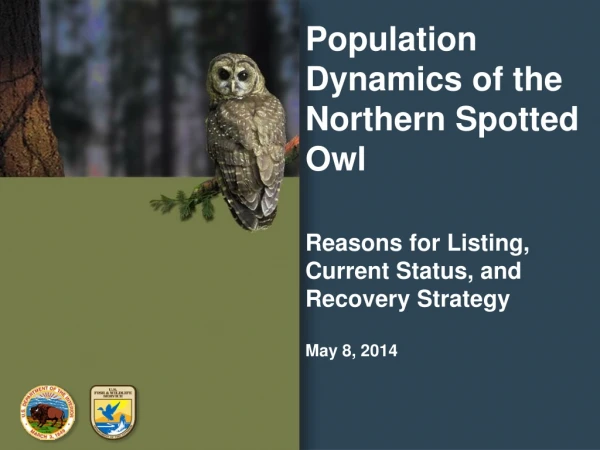
Population Dynamics of the Northern Spotted Owl Reasons for Listing, Current Status, and Recovery Strategy May 8, 2014
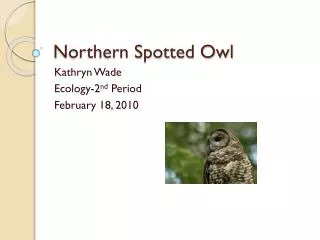
Northern Spotted Owl • Listed as threatened in 1990 • Late-successional forest habitat • Territorial, large (~1500ha) home ranges. Nest in spring (Mar-Jun) • High annual survival, variable reproduction • Threats: Habitat loss, barred owls • Declining population trends
Northern Spotted Owl Recovery Plan(s) and Critical Habitat Rule(s) • 1990 – NSO Listed as Threatened • 1992 – Final Draft Recovery Plan/Critical Habitat • 1994 – Northwest Forest Plan • 2008 – 2008 Final Recovery Plan and Revised Critical Habitat • 2009 – 2008 Plan/Critical Habitat Remanded by Court Order • 2011 – Final Revised Recovery Plan • 2012 – Final Revised Critical Habitat • 2013 – Final EIS for Barred Owl Removal Experiment
Key Threats • 1990 • Widespread habitat loss across the species’ range • Inadequate regulatory mechanisms to conserve the owl/habitat • Low population sizes/declining populations • Limited habitat/declining habitat • Inadequate distribution/isolation of habitat and populations • Vulnerability to natural disturbance • Predation/competition (barred owls?)
Key Threats • 2011 • Barred owls • Past habitat loss • Current habitat loss • Disease • Climate change
Population Monitoring • Effectiveness Monitoring for the Northern Spotted Owl • Assess status and trends in northern spotted owl populations and habitat: • Will implementing the Northwest Forest Plan reverse the downward trend in spotted owl populations?
Northern Spotted Owl – Current Status • STATUS AND TRENDS IN DEMOGRAPHY OF NORTHERN SPOTTED OWLS: • 1985-2008 - Forsman et al. (2011)1985-2013 – in prep. • Meta-analyses:1991,1993,1998, 2004, 2009, 2014 • 11 long-term study areas
Northern Spotted Owl – Current Status: 1990-2008 Forsman et al. (2011).
Northern Spotted Owl – Current Status: 1985-2008 Estimates of realized population change (Δλ) on study areas
Northern Spotted Owl Current Status: 1985-2008 Factors Affecting Demographic Rates • Amount of Habitat: • Positive effect on fecundity (4 areas) • Positive effect on recruitment in meta-analysis of population growth rate (λ) • Presence of Barred Owls: • Negative effect on fecundity on 4 study areas • Negative effect on survival on 5 study areas • Negative effect on recruitment in meta-analysis of population growth rate (λ) • Weather & Climate: • Negative effect of cold, wet springs (nesting periods) on fecundity Forsman et al. (2011)
Barred Owls Barred Owl (Strix varia) Spotted Owl (Strix occidentalis)
Barred Owl Range (Pre-1900)
Barred Owl Range (Spotted Owl) Blue – Barred Owl Red – Spotted Owl (Northern, California, and Mexican
Timeline of Barred Owl Threat Recognition • 1990 - Listing of Northern Spotted Owl • Barred owl competition “… of considerable concern …” but limited information available • 2004 - SEI Report for 5-Year Review • Barred owl - concern increased, especially north • Level of concern as strong as habitat concerns • 2011 – Revised Recovery Plan • Barred owl 1 of 3 primary threats • 10 Recovery Actions relative to the barred owl
Barred Owl Competition with Northern Spotted Research Studies • Wiens (2012) • NSO – selected steep areas dominated by old conifers • BO – more even use of forest types, flatter slopes • BO – 6x as many young • Northern flying squirrel and woodrats – important prey for both, but • BO- used many additional aquatic, terrestrial, and diurnal spp. • Survival of both species was positively related to old conifer • Singleton (2013) • BO – gentler slopes/lower elevation • BO – broader range of forest structure • NSO occupancy declined less at sites • with good habitat • Kelly et al. (2003) • NSO occupancy declined after BO detection • Hamer et al. (2007) • NSO and BO home range size correlated with old forest • NSO avoid younger forest, BO use in prop to availability • Dugger et al. (2011) • BO- negative effect on NSO site colonization • BO- positive effect on NSO site extinction • Less old forest higher site extinction • rates • Less fragmented old forest higher colonization rates
Northern Spotted Owl (Strix occidentalis caurina) Barred Owl (Strix varia) D. Wiens
Recovery Objectives • Populations are sufficiently large and distributed such that the species no longer requires listing. • Adequate habitat is available and will continue to exist to allow the species to persist without protection of the ESA. • Effects of threats have been reduced or eliminated such that populations are stable or increasing.
How Do We Recover the Northern Spotted Owl? • Threats: Habitat AND Barred Owls • HABITAT • NWFP • 2011 Recovery Plan - Recovery Action 10,12, 32 • 2012 Critical Habitat Rule • Barred Owls • 2011 Recovery Plan - Recovery Actions 22-31 • Removal Experiment - Implemented in 2013