Download
1 / 15
150 likes | 281 Vues
The intertidal zone, a dynamic area along coastlines, lies between the highest high tide and the lowest low tide. This unique environment hosts diverse communities shaped by habitat type—rocky shores and soft bottoms. While rocky shores provide stability and attachment for organisms, soft bottoms are unstable and nutrient-rich, supporting filter and deposit feeders. Organisms adapt to challenges such as water loss, temperature fluctuations, and salinity changes. This zone showcases remarkable adaptations for survival, making it crucial for marine biodiversity.

E N D
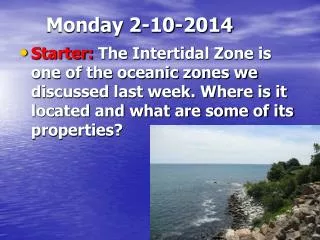
Monday 2-10-2014 • Starter: The Intertidal Zone is one of the oceanic zones we discussed last week. Where is it located and what are some of its properties?
Intertidal Zones Intertidal zone – narrow fringe along the shoreline that lies between the highest high tides and lowest low tides
Intertidal Zones unique to marine environments because it is regularly exposed to air animals in this zone must cope with both exposure to air and submersion in water
Types of Bottoms • the nature of the community depends on the type of bottom of the intertidal zone 2 different types of habitat: • rocky shore • soft bottoms
Rocky Shore Communities rocky shores generally occur in steep coasts without large amounts of sediment
Rocky Shore Communities more stable living things in this area have places to attach
Soft Bottom Communities • any bottom that is composed of sediment, not rock • Occur where sediments accumulate • ex. near river mouths
Soft bottom Communities • Unstable and constantly shift in response to waves, tides, and currents • No solid place for attachment
Adaptations Water Loss • run and hide • ex. shore crabs, snails, hermit crabs • “clam up” • Ex. Barnacles, mussels • use mucus to get a better seal
Adaptations Temperature • run and hide • pronounced ridges on shells • help animal lose excess heat • color of shells • white, brown
Adaptations Salinity • “clam up” • during rain to keep out fresh water • Burrowing • reduce activity
Adaptations Restriction of Feeding • hardest in rocky intertidal because little or no sediment • most in this zone are filter feeders • easier in soft bottom areas because lots of sediment • deposit feeders
Adaptations Wave Shock • easier to cope with in soft bottom because sediment provides shelter • holdfasts to attach to rocks • byssal threads • suction cups • no swim bladders • help animals stick to bottom
Adaptations Getting around • soft bottom animals usually burrow • muscular “foot” like mussels • segmented/soft body animals • rocky bottom animals • no soft bodied animals • hard outer shells • legs or swim using shell