Download
1 / 6
70 likes | 175 Vues
This guide explores standard reduction potentials and their significance in electrochemical cells. Half-reactions are conventionally written as reductions, enabling the calculation of overall cell reactions. The example of the Daniell cell demonstrates oxidation of zinc and reduction of copper ions. Emphasis is placed on understanding how electric potentials arise from charge separation, the significance of standard states, and the properties of cell potentials. Key concepts such as intensive properties and reversal of reactions are discussed for clarity in electrochemistry.

E N D
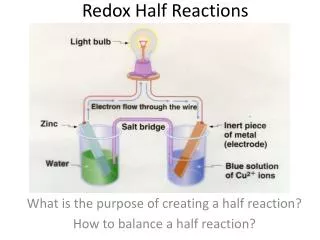
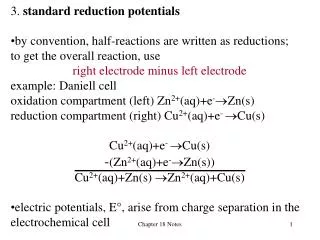
3. standard reduction potentials • by convention, half-reactions are written as reductions; • to get the overall reaction, use • right electrode minus left electrode • example: Daniell cell • oxidation compartment (left) Zn2+(aq)+e-Zn(s) • reduction compartment (right) Cu2+(aq)+e- Cu(s) • Cu2+(aq)+e- Cu(s) • -(Zn2+(aq)+e-Zn(s)) • Cu2+(aq)+Zn(s) Zn2+(aq)+Cu(s) • electric potentials, E°, arise from charge separation in the electrochemical cell Chapter 18 Notes
“standard” means elements in their standard states, aqueous ions at concentration of 1 M (really 1 m) • potentials are intensive properties: doubling the reaction does not increase the charge separation and does not double the potential! • if a reaction is reversed, the potential changes sign • potentials for half-reactions are determined by assigning the reduction potential for • H1+(aq)+1e-1/2H2(g) • to E°=0 V exactly; all other potentials are compared to this cell Chapter 18 Notes
measured cell potential is 0.76V • assign half-cell potential for H2/H+electrode as 0.0 V • half-cell potential for Zn/Zn2+ is thus 0.76 V Figure 18.3 Chapter 18 Notes
measured cell potential is 0.34V • assign half-cell potential for H2/H+electrode as 0.0 V • half-cell potential for Cu/Cu2+ is thus 0.34 V Figure 18.4 Chapter 18 Notes
example: • Calculate the cell potential for the • Zn(s)Zn2+(aq) Cu2+(aq) Cu(s) • cell. • Zn has a higher reduction potential than Cu, so Zn is a stronger reducing agent (Zn will reduce Cu2+) • both Cu and Zn have higher reduction potentials that H2 so both Cu and Zn can reduce H1+ Chapter 18 Notes