Advantages and Challenges of Adjoint-Based Gradient Calculations in Parameter Estimation
This document discusses the advantages and challenges of adjoint-based gradient calculation methods, especially in the context of optimizing parameter estimation for models like the Norne field simulator. It outlines the motivation for using adjoint methods, provides a simple illustrative example, and examines the hurdles faced, particularly regarding output constraints. The findings emphasize the potential for significant runtime improvements but also highlight the complexities in managing constraints for accurate forecasting in reservoir and well modeling.

Advantages and Challenges of Adjoint-Based Gradient Calculations in Parameter Estimation
E N D
Presentation Transcript
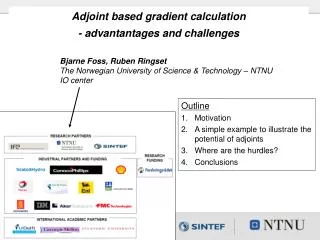
Adjoint based gradient calculation - advantantages and challenges Bjarne Foss, Ruben Ringset The Norwegian University of Science & Technology – NTNU IO center • Outline • Motivation • A simple example to illustrate the potential of adjoints • Where are the hurdles? • Conclusions
Motivation Model Norne field StatoilHydro Eni, Petoro Data
Optimize Parameter estimation Motivation now now time history well schedule model simulator forecast for k=1 to N ...simulate(k) end + Uncertainty
Motivation Inlet separator Pipelines/tankers Market Wells Pipelines Reservoir Process Utilities Reservoir and well models (Eclipse) Network model (GAP, MaxPro, OLGA) Process model (HYSIS) Application Value chain optimization Optimization requires a large number of gradient calculations Efficient gradient computations are important
Adjoint gradient computation Forward simulation
Adjoint gradient computation One forward simulation One reverse simulation
Forward method N forward simulations (nested loops)
The output constraint challenge – possible remedies Reducing the number of constraints • Enforcing them on parts of a prediction horizon • Lumping output constraints together • One interesting application of this is found in the Standford GPRS reservoir simulator (Sarma et al, 2006)
The output constraint challenge – possible remedies Reducing the number of constraints • Enforcing them on parts of a prediction horizon • Lumping output constraints together • One interesting application of this is found in the Standford GPRS reservoir simulator (Sarma et al, 2006) Taking advantage of barrier or interior point optimization methods • Removing output constraints without introducing slack variables • Model constraints (i.e. equality constraints) can be removed by a single shooting method (in eg. MPC)
Adjoint based gradient calculation - advantantages and challenges • Conclusions • Adjoint based gradient calculation may give huge improvements in run-time • Output constraints is a challenge
Once again - A very simple example Let Lagrangian function and assume that is the independent variable, i.e. Compute the gradient wrt (”reverse simulation”) Choose