Download
1 / 50
500 likes | 609 Vues
This document provides a comprehensive overview of the H1N1 influenza pandemic, detailing its epidemiology, transmission dynamics, and the impact on public health. It differentiates between pandemics and epidemics while discussing the statistics of severe illness and mortality associated with influenza. The report emphasizes the importance of vaccination and available treatments, such as Oseltamivir and Zanamivir, in mitigating the outbreak. It also addresses local surveillance and case studies to illustrate the outbreak's effects on communities.

E N D
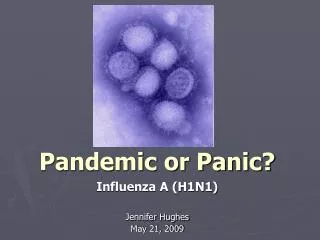
Pandemic or Panic? Influenza A (H1N1) Jennifer Hughes May 21, 2009
Outline • Influenza outbreaks, epidemics and pandemics • Epidemiology of novel H1N1 SOIV • Our local picture • Vaccine • Things you should know about treatment
Epidemic: From the Greek epi (upon) + demos (people): affecting a disproportionately large number of individuals within a population at the same time. Pandemic: pan (all) + demos (people): occurring over a wide geographic area.
Influenza • High attack rates • Low mortality (on average) – 0.1% - 20% • More people have died from influenza in a short period time than from any other disease. • Affects birds and mammals
Influenza A • Surface glycoproteins: • HA (hemoagglutinins) • NA (neuraminidases) • H1, H2, H3 • N1, N2
A typical flu year • Two flu seasons (one per hemisphere) • 2-5 million cases of severe illness • 500,000 deaths worldwide • Annual pandemic?
Remember H5N1 ? • Avian-adapted, highly pathogenic • Endemic and panzootic in birds • Not efficiently or sustainably transmitted to humans or between humans • 2008 : 44 cases, 33 deaths (75% mortality) • 2009: 29 cases, 11 deaths (38% mortality)
SARS for comparison • SARS coronavirus • Near pandemic between Nov 2002 – July 2003 • 8096 cases, 774 deaths • Case fatality rate 9.6% • Last human case 2003 • “fully contained”
Tracing the beginning • March 18 – Mexico reports increase in late-season ILI • April 21 samples are sent to CDC to confirm • First death April 13 • Diabetic woman from Oaxaca • 2 Children San Diego country diagnosed April 24
Mexico • 3648 cases • 72 deaths • Hospitalization rates high in young people • Surveillance challenging
H1N1 outbreak: what is known • Novel virus (to animals and humans) • No pre-existing immunity • More contagious than seasonal influenza • Primary attack rate 35% • Unclear origin
Mild illness (except Mexico) • Severe and lethal cases seen in younger patients • Case fatality rate estimate of 0.3-1.4% • Could result in 6-12 million deaths WHO Rapid Pandemic Assessment Collaboration
The current H1N1 SOIV situation… • 21 May 2009 06:00 • 41 countries • 11 034 cases • 85 deaths • 791 cases since May 20 • 5 new deaths
Alberta’s cases • 30 had traveled to affected areas; • 9 in contact with travelers • 16 no travel history • 31 cases have travel/exposure histories to be determined. • Median 33 years of age
Gift Lake, Alberta • Woman in 30s with chronic underlying medical conditions • No travel to Mexico • Household contact + H1N1 SOIV • Died in Edmonton April 28, 2009 • Autopsy report May 14 : inconclusive about role of H1N1
Reverse Zoonosis in Alberta • Rocky Mountain House • 2200 pigs under quarantine • “some” animals had Influenza A H1N1 • From carpenter who traveled to Mexico • 500 culled for overcrowding
Testing • NP swab or aspirate • M5 Universal Transport Medium • “Influenza testing” on ProvLab req (mark as “EI 236”) • Prov Lab requisition
Across the Region • PLC • ACH • FMC • RGH
Laboratory Diagnosis • Confirmed case definition: • RT-PCR • Viral culture • 4 x increase in H1N1 specific neutralizing AB • Probable case: • Positive testing for influenza A • Untypable, with/without clinical sx
Reporting • Mild ILI – report if you swabbed them • Severe - call MOH on call • Positive results followed by public health
Infection Prevention & Control • Patients • Health care workers • Site to site
Respiratory Precautions • Within 2 m of patient • Surgical mask • Patient is compliant with resp hygiene • Weak or no cough • N95 mask • Aerosol-generating medical procedures • Non-compliant patient
Vaccine • Current seasonal flu vaccine: no immunity • H1N1 vax available in 5-6 months • Global capacity of 1-2 billion doses/year • Will not be incorporated into seasonal vaccine • 1 vs 2 doses? • Federal gov + GlaxoSmithKline have signed a deal for Canadian Production
Treatment • Oseltamivir (Tamiflu): Roche • Zanamivir (Relenza) : GlaxoSmithKline • Neuraminidase inhibitor : prevents virion release from infected cells • Age-based, weight-based dosing in children • Pregnancy Category C • Most effective when started within 48 hours
Oseltamivir • 25-30% reduction in symptom duration • 59% reduction in hospitalization • 63% reduction in antimicrobial use • 1 day reduction in work days lost • Reduction in mortality (OR 0.21, p<0.03) • Statement on influenza vaccination for the 2008-2009 season. An Advisory Committee Statement (ACS). Can Commun Dis Rep 2008 Jul 15;34(ACS-3):1-46. Available at: http://www.phac-aspc.gc.ca/publicat/ccdr-rmtc/08pdf/acs-3.pdf • Centers for Disease Control and Prevention. Antiviral agents for seasonal influenza: dosage. 2009 [updated 2009 Feb 11, cited 2009 Mar 20]. Available at: http://www.cdc.gov/flu/professionals/antivirals/dosage.htm
Oseltamivir in Canada • NOT RECOMMENDED for treatment or prophylaxis of mild cases • Tamiflu use should be consistent with use for seasonal influenza
Indications for Tamiflu • All hospitalized patients with confirmed, probable or suspected influenza (novel or seasonal) • Patients who are at higher risk for seasonal influenza complications
Indications for Tamiflu • Influenza-like illness • < 48 hours onset • High risk of influenza-related complications • cardiac or pulmonary disorders • diabetes mellitus • cancer • immunodeficiency • renal disease • anemia or hemoglobinopathy • conditions that compromise the management of respiratory secretions • children with conditions treated for long periods with acetylsalicylic acid • children < 2 years • pregnant women • > 65 years
Who should get PEP? • Close contact of case (suspected, probable and confirmed) • High risk for complications of influenza • Health care workers with recognized, unprotected close contact exposure • During infectious period (Day 0 – Day 7)
Canada’s pandemic plan • Stockpile to treat 17.5% of population • 55.7 million doses stockpiled in Canada • 5 million doses of zanamivir • Alberta would get ~10% Canadian Pandemic Influenza Plan for the Health Sector :The Use of Antiviral Drugs During a Pandemic. Public Health Agency of Canada. May 12, 2009.
Oseltamivir in the Region • Available for purchase by prescription • NOT a restricted medication • Hospitals and outpatient pharmacies have stockpile for MOH cases
Neuraminidase Resistance • HIN1 SOIV • 101 isolates : 0 % resistance to neuraminidase inhibitors • 96 isolates : 100% resistance to adamantanes http://www.cdc.gov/h1n1flu/recommendations.htm#table2
Speculating on the future • Clinical spectrum not yet fully apparent • Spread to southern hemisphere/interaction with seasonal flu • Antigenic drift of influenza viruses
Assessing the severity of an influenza pandemic • Inherent virulence • Population vulnerability • Waves of spread • 8 gene segments commonly and unpredictably mutate • Capacity to respond
WHO Phase 5: sustained community-level outbreaks in at least two countries in one WHO region. • Pandemic is “imminent” • Currently “sustained community-level outbreak”
Staving off a pandemic? • May 18, 2009: Britain, Japan, China, US and others urge WHO to change its definition of a pandemic to reflect the virulence of a disease, not just how far it spreads around the world.
Summary • First wave of the outbreak appears mild • Future is unpredictable • Still on upswing of epidemiological curve • Vaccine is still months away • Oseltamivir and zanamivir work… for now • Major political and economic impacts of pandemic
References Public Health Agency of Canada. FightFlu. Http://www. Fightflu.ca. Access May 20, 2009. The Lancet: H1N1 Resource Centre: http://www.thelancet.com/H1N1-flu McGeer A, Green KA, Plevneshi A, et al. Antiviral therapy and outcomes of influenza requiring hospitalization in Ontario, Canada. Clin Infect Dis 2007;45:1568-75. Kaiser I, Wat C, Mills T, et al. Impact of oseltamivir treatment on influenza-related lower respiratory tract complications and hospitalizations. Arch Intern Med 2003;163:1667-72. Cooper NJ, Sutton AJ, Abrams KR , et al. Effectiveness of neuraminidase inhibitors in treatment and prevention of influenza A or B: systematic review and meta-analysis of controlled trials. BMJ 2003;326:1-7. Canadian Pandemic Influenza Plan for the Health Sector: The Use of Antiviral Drugs During a Pandemic. Annex E. Public Health Agency of Canada. May 12, 2009. http://www.phac-aspc.gc.ca/cpip-pclcpi/pdf-e/annex_e0513-eng.pdf Aoki FY , Macleod MD, Paggiaro P, et al. Early administration of oral oseltamivir increases the benefits of influenza treatment. J Antimicrob Chemother 2003;51:123-9. Balicer RD , Huerta M, Davidovitch N, et al. Cost benefit of stockpiling drugs for influenza pandemic. Emerg Infect Dis 2005;11:1280-2.



![Pandemic [H1N1] 2009 RT Education Module 1](https://cdn0.slideserve.com/555920/pandemic-h1n1-2009-rt-education-module-1-dt.jpg)