Parallelism: Correlative Pairs
This mini-lesson from the UWF Writing Lab focuses on the importance of parallelism in writing. It explains how items in a series should be balanced and coordinated to convey equality and clarity. Emphasizing the use of parallel grammatical constructions, the lesson clarifies common mistakes involving correlative pairs, providing correct examples to enhance understanding. Key correlative conjunctions such as "both...and," "either...or," and "not only...but also" are highlighted to help writers improve their sentence structure and overall writing effectiveness.

Parallelism: Correlative Pairs
E N D
Presentation Transcript
Parallelism: Correlative Pairs From the UWF Writing Lab’s Grammar Mini-Lessons Series Mini-Lesson #75
Items in a series should be balanced or coordinated; that is, to indicate the same rank and role of items in a series or to indicate equality of these ideas, writers of standard written English must employ parallel grammatical constructions.In order to ensure that these are grammatically similar, the writer conveys his or her message in parallel language. Some writers make a construction appear to be parallel when actually it is not by incorrectly mixing the parts of correlative pairs.
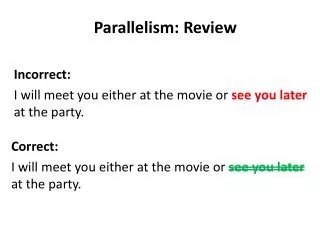
Correlative pair is neither… nor. • Incorrect: I readily admitted that I had neither interest or need for this seminar • Correct: I readily admitted that I had neither interest nor need for this seminar. • Correlative pair is not only… but also. • Incorrect: The Beatles were talented not only as performers but as composers. • Correct: The Beatles were talented not only as composers but also as composers.
Frequently Used Correlative Conjunctions • Both… and • Either… or • Just as… so • Neither… nor • Not only… but also • Whether… or