Download
1 / 10
100 likes | 216 Vues
Sociology examines how society is structured and how individuals interact within various social institutions such as family and education. Sociologists employ methods like theoretical analysis, statistics, and observation to explore these dynamics. Four main theories in sociology include Functionalism, which emphasizes societal roles and interdependence; Marxism, focusing on class conflict; Feminism, highlighting gender disadvantages in a patriarchal society; and Interactionism, which studies interactions within small groups. Each theory offers unique insights into understanding societal functions.

E N D
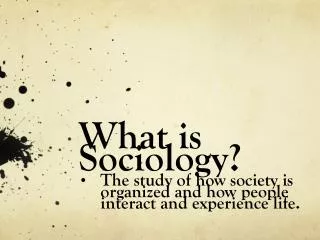
What is Sociology? The study of how society is organized and how people interact and experience life.
How do we study it? • Sociologists investigate the structure of groups, social institutions (like the family, school, prisons, etc) and how people interact within these settings. • Methods used:theoretical analysis, stats, and observation.
4 MAIN THEORIES TO KNOW • (Sociology theories are just different views about how society works) • 1) Functionalism • 2) Marxism • 3) Feminism • 4) Interactionism
Functionalist Perspective • Functionalists believe we each have a ROLE/FUNCTION [a job to do] and we are interdependent upon each other to contribute to society functioning as a whole (MACRO/big picture). • We each have a role and a piece in the big puzzle. • We share values, norms, attitudes and beliefs (consensus) • Change is generally viewed as disruptive and gradual. • Example: The Macro BIG PICTURE of our Education system: *Role of all teachers = to educate & enforce proper behaviour and a life skill-set so that all students will be prepared for adulthood.
Marxist Perspective (Macro) • Society is dominated by the ruling class (the big wigs at the top of the food chain have the power). • Power = control, money, access, prestige, privilege, authority, respect… • Society based on conflict: the WORKING CLASS [called the proletariat] are in conflict with the RULING CLASS [called the bourgeoisie/elite]).
Feminist Theory (Macro) • Feminism is considered to be a “structural theory”(we are all passive puppets manipulated by society to perform our roles) and women are primarily at a disadvantage to men in today’s Patriarchal (male dominated and empowered) society. • (macro level structural theory)
Feminists believe women function in the family as subordinate members because their role is reduced to… • 1) Reproducing the labour force (populating and nurturing children) • 2) Performing “unpaid/free labour” services in the home. • 3) Absorbing the anger/stress of the family and their partner (women are pressured to create a stable and stress free home environment). • 4) Serving the needs of men within marriage (sexually; as the nurturer; providing free domestic work and primarily in charge of the household; main child care provider, etc).
Interactionist Perspective (Micro) • Studies society through interactions within individual and small (micro scale) groups. • Interaction between individuals is negotiated through shared symbols, gestures and verbal + nonverbal communication • Interactionists ask questions like: • How do individuals experience one another? • How do they interpret the meaning of these interactions? • How do people construct a sense of self identity through this?
What do you think? • Your group has been assigned one question based on one of the theories we have discussed. • What would a theorist (based on the specific THEORY YOU HAVE BEEN GIVEN) have to say about the pictures and info on your sheet? • Write down your answers together and be prepared to share with the class.