Download
1 / 53
540 likes | 662 Vues
This educational resource explores the evolutionary history of vertebrates transitioning from aquatic to terrestrial life. Students will discover the development of tetrapods, including amphibians, reptiles, birds, and mammals, from fish ancestors. Key adaptations for surviving on land—such as lung development, limb evolution from fins, and skin features—will be discussed, along with the significance of metamorphosis in amphibians. Insights into reptilian traits, egg structures, and their evolutionary adaptations will also be covered, highlighting the diversity within the animal kingdom.

E N D
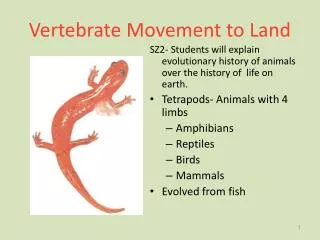
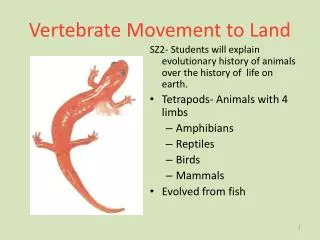
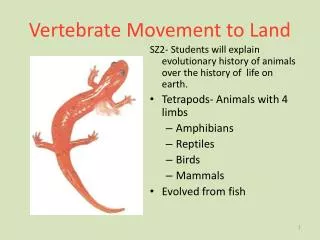
Vertebrate Movement to Land SZ2- Students will explain evolutionary history of animals over the history of life on earth. • Tetrapods- Animals with 4 limbs • Amphibians • Reptiles • Birds • Mammals • Evolved from fish
Transitional Tetrapods Skull, teeth, limbs similar to lobe-finned fish Acanthostega Ichthyostega
Adaptations to live on land • Gills are usually lost • Lungs function • Breathe through skin • Secrete mucus • Prevent dehydration • Aids in respiration
More Adaptations to live on land • Skeleton • Fins evolve into limbs • Vertebral column supports body underneath it AIR IS NOT AS BOUYANT AS WATER.
Evolution of Circulation Fish Amphibian
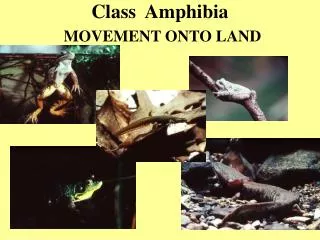
Kingdom Animalia Phylum Chordata Subphylum Vertebrata Class Amphibia 1stland vertebrates Ex: frogs, toads, & salamanders
Class Amphibia– “Double Life”frogs, toads, salamanders, & newts Characteristics • “Double Life” -lives part of its life in water and part on land • Ectothermic- “outside heat”- body temp. regulated by environment • no scales or claws • Have thin, moist skin
AMPHIBIAN METAMORPHOSIS Egg- tadpole- adult • larvae are herbivores, adults carnivores • larva have tails to move in water • external fertilization with no parental care • lay eggs without shells in water
Amphibian Body Plan • Bilateral symmetry • 3 chambered heart • Larvae breathe through gills; adults breathe through lungs • Breathe through thin, moist skin (produces mucus) • Changes from larva to adult through the process of metamorphosis
Class AmphibiaOrder Anura • Anura- an=without, ura= tail • Tailless • Hindlegs adapted for jumping and swimming • Tympanum (ear drum) and larynx well developed Ex. Frogs and toads frog dissection intro- http://www.kiz-oyunlari.com/files/file/kurbaga_ameliyat.swf
Class AmphibiaOrder Caudata • Caudata- “have a tail” • Long tail • 2 pairs of limbs Ex. Salamanders and newts
Class Amphibia:Order Gymnophiona(Apoda) Gymnos- naked ophis- snake live in tropics Elongated body Limbless carnivores Ex. Caecilians – “blind”-small eyes
Kingdom Animalia Phylum Chordata Class Reptilia Ex: snake, turtle, lizards crocodile, dinosaurs
Reptilian Traits: 3 chambered heart (except for crocodilians- imperfect 4) Ectothermic Paired limbs with five toes and claws Tough, dry, scaly skin (horny epidermal scales) Jaws adapted for crushing and gripping Breathe with lungs metanephric kidney- produces uric acid to reduce water loss Large cerebrum as compared to rest if brain- behaviors- 1. instinct 2. learned
Reptile Legs • Short tetrapods for walking • Positioning of the legs more directly under the animal. This position provided more support than the splayed arrangement of the Amphibian legs.
Reproduction: Internal fertilization (to avoid desiccation of gametes), oviparous Lay amniotic eggs on land- no dependence on water Shells leathery, sometimes calcareous
Amniotic Egg Structures & Functions • Chorion provides a special hard covering that is permeable to respiratory gases (O2 and CO2) while being impermeable to water vapor. • Allantois is a storage reservoir for metabolic waste products such as nitrogenous compoundsand gas exchange. • Amnion is a fluid filled sac that acts as a cushion for the embryo and also prevents desiccation. • Yolk saccontains food for the embryo, thus eliminating the need for a larval stage.
Phylum Chordata Subphylum Vertebrata Class Reptilia Order Testudine: • Body in a bony case • dorsal carapace(top of shell) • ventral plastron(bottom of shell) • Jaws with a horny beak, no teeth • Vertebrae and ribs fused • Ex. Turtles and tortoises
Phylum ChordataSubphylum VertebrataClass ReptiliaOrder Sphenodonta • Primitive reptile • closely related to dinosaur • Looks like lizard • Diapsid skull Ex. Tuatara- only living species
Phylum Chordata Subphylum Vertebrata Class Reptilia Order Squamata Diapsid skull with two temporal openings Skin is shed with horny epidermal scales Jacobson’s organ- sense of smell Movable skin, kinetic skull Poisonous- hemotoxins (blood) , neurotoxins(nervous system) EX. Snakes and lizards Lizards have movable eyelids Snakes- descended from tetrapod ancestor dichotomous key
Phylum ChordataSubphylum VertebrataClass ReptiliaOrder Crocodilia • Elongated massive skull • Imperfect 4 chambered heart • crocodiles, alligators, and caimans, gavials
Crocodilians Crocodiles, Alligators, Caimans, & Gavials
Gavial(gharial) Carnivores, “ghara”- pot- bulb on snout 12.25- 15.5 ft. long Rivers of India, Nepal, Pakistan, Bhutan, Bangladesh Critically Endangered
Crocodile Largest, best predatos Live in/near Salt water American Crocodile- Endangered Most in Australia
Caiman Rivers/swamps of Central and South America 3ft- 16 ft. (only in black caiman species)
The temperature inside the nest of several crocodilian species decides the sex of the young. ~50-80 eggs • If the nest temperature is 30ºC, females will hatch • If the temperature is above 34ºC - males. • If the temperature is in between- young of both sexes.