Enhancing Neutron Identification in PHENIX: Scintillator Veto for FCAL
This presentation by Ming Liu discusses the deployment of scintillator paddles in front of the Forward Calorimeter (FCAL) to identify neutrons and enhance particle detection in the PHENIX experiment. Originally built for d+Au centrality measurement in Run 3, the scintillators serve to veto charged hadrons and interactions. The aim is to enable the study of forward diffractive neutrons, which exhibit noteworthy transverse asymmetries. Key calibration methods, operations, and ongoing data analysis from Run 9 are also outlined, emphasizing the potential for clean luminosity monitoring.


Enhancing Neutron Identification in PHENIX: Scintillator Veto for FCAL
E N D
Presentation Transcript
FCal Status Ming Liu
What is FCAL? • Originally built for d+Au centrality measurement, Run3 • How many people know about FCAL in PHENIX? Ming Liu SPIN PWG 3/4/09
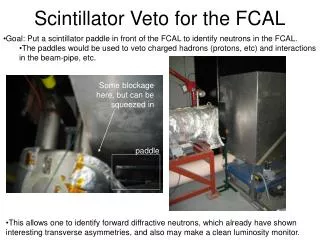
Run9: Scintillator Veto for the FCAL • Goal: Put a scintillator paddle in front of the FCAL to identify neutrons in the FCAL. • The paddles would be used to veto charged hadrons (protons, etc) and interactions in the beam-pipe, etc. Some blockage here, but can be squeezed in paddle • This allows one to identify forward diffractive neutrons, which already have shown interesting transverse asymmetries, and also may make a clean luminosity monitor. Ming Liu SPIN PWG 3/4/09
Calibrations • Monitor gain variations: • LED calibration – done by shift crew • Cosmic calibration • by expert now • considering to leave it in the hands of shift crew
ADC spectra (lowPost-lowPre) 1300V 1250V 1150V 1100V
Online monitor & Operation • Shift crew check the outputs and operate the detectors: • HV, should be on all the time • LV, may need to cycle LV if having problems with data, G-Link loss etc.
Data from run9 • A lots of things to do/learn • Timing - done • HV scan for pp • Use run8 values • Calibration • LED data • Cosmic data • Trigger threshold scan, done • Data analysis • Work in progress Ming Liu SPIN PWG 3/4/09
Physics: Transverse Physics w/ ZDC+FCAL ? Beam Pipe pT ~0.3GeV pT ~1.0GeV 10 cm • Mandelstam t ~ pT2 ~(500*x/1800)2, so FCAL might extend the ability to study AN as a function of t FCAL Ming Liu SPIN PWG 3/4/09