Advancing Space Weather Research through Small Satellite Missions: NSF Workshop Insights
The NSF Small Satellite Workshop held from May 15-17, 2007, at George Mason University, explored the potential of small satellites in space weather research. About 150 participants from academia, government, and the aerospace industry discussed launch opportunities, innovative technologies, and the educational benefits of small satellites. Key findings revealed the feasibility of missions in the $1M-$10M range, addressing observational gaps and inspiring future researchers. The workshop underscored the necessity for low-cost access to space for successful implementation, aiming for a $5M-$10M annual program.

Advancing Space Weather Research through Small Satellite Missions: NSF Workshop Insights
E N D
Presentation Transcript
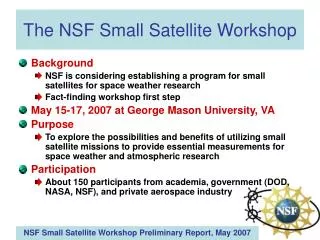
The NSF Small Satellite Workshop • Background • NSF is considering establishing a program for small satellites for space weather research • Fact-finding workshop first step • May 15-17, 2007 at George Mason University, VA • Purpose • To explore the possibilities and benefits of utilizing small satellite missions to provide essential measurements for space weather and atmospheric research • Participation • About 150 participants from academia, government (DOD, NASA, NSF), and private aerospace industry NSF Small Satellite Workshop Preliminary Report, May 2007
Scope of the Workshop • Topics • Launch opportunities for small spacecraft • Innovative technology developments for small satellite systems • Miniaturization of scientific payloads • Advancing research by means of measurements from small satellites • Key space weather needs that can be satisfied by small satellite observations • Using small satellites as an educational tool for science and engineering NSF Small Satellite Workshop Preliminary Report, May 2007
Some Main Findings • It is feasible • Scientific satellite missions in the $1M-$10M range (incl. launch) are possible • It will advance space weather research • Such missions can help fill important observational gaps • They will inspire the development of new experimental methods and technology • It has Educational benefits • Such missions play a crucial role in training the next generation of experimental space scientists and aerospace engineers. • The main obstacle is access to space! • While launches and launch opportunities are plentiful, securing regular, low-cost access to space for small scientific payloads is non-trivial NSF Small Satellite Workshop Preliminary Report, May 2007
Developing a NSF Satellite Program Supporting Space Weather • Next steps • Inventory current and future space weather observational capabilities and needs to identify gaps that can be filled using pico-, nano-, and micro-satellites • Solicit ideas in the form of pre-proposals or white papers (providing specific guidance on cost and technical constraints) • Establish partnerships with other government agencies and private industry to secure a series of regular, low-cost launches • Construct a 5 to 10 year program based on responses to solicitation and conduct annual proposal competitions consistent with programmatic plans and space weather goals • The goal: A continual program of $5M - $10M per year • To advance space weather and atmospheric research and education through development, building, launch, operation, and data analysis of small scientific satellite missions NSF Small Satellite Workshop Preliminary Report, May 2007
Partnering: Seeking the Help of Launch Providers • Short term • Cubesats (and derivatives) likely to be the first technical focus • We need to secure regular (at least 2/year), low-cost PPOD launches for the program, starting 2009 • Future • Exploring other Secondary Payload options • Exploring cheap dedicated launches • Information and Contact • http://virbo.org/wiki/index.php/SSW • Therese Moretto Jorgensen tjorgens@nsf.gov NSF Small Satellite Workshop Preliminary Report, May 2007