Optimizing FGT Disk Layout for Enhanced Electron Reconstruction Efficiency in 40 GeV W Decay Studies
The Forward Gluon Tracker (FGT) project aims to refine electron and hadron separation and improve the reconstruction of electron charge from W decay at transverse momenta up to 40 GeV/c. Key objectives include uniform performance across varied z-vertices, maximizing tracking efficiency, and minimizing material interaction. The optimization of disk geometries and layouts ensures sufficient hit coverage for effective tracking across different rapidity ranges. Simulation results guide the development of the configurations to meet detector requirements and enhance overall performance.

Optimizing FGT Disk Layout for Enhanced Electron Reconstruction Efficiency in 40 GeV W Decay Studies
E N D
Presentation Transcript
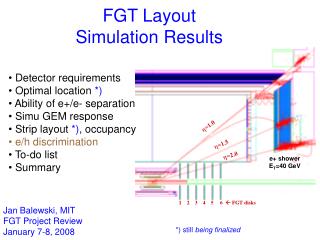
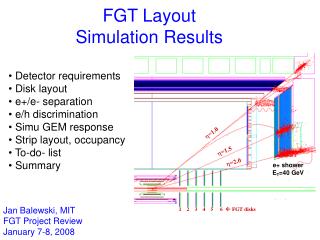
=1.0 =1.5 =2.0 1 2 3 4 5 6 FGT disks FGT Layout Simulation Results • Detector requirements • Disk layout • e+/e- separation • e/h discrimination • Simu GEM response • Strip layout, occupancy • To-do- list • Summary Jan Balewski, MIT FGT Project Review January 7-8, 2008 e+ shower ET=40 GeV
FGT Requirements • Reconstruct charge of e+, e- from W decay for PT up to 40 GeV/c • Discriminate electrons against hadrons • Allow for uniform performance for z-vertex spread over [-30,+30] cm • Fit in geometrical space free up by the West Forward TPC (FTPC) • Benefit from limited coverage of other trackers: IST, SSD • Relay on vertex reconstruction and Endcap shower-max hit • Relay on Endcap towers for energy reconstruction • Minimize amount of material on the path of tracks • Align FGT segmentation with TPC sector boundaries and Endcap halves • Assure relative alignment vs. TPC is double with real particles
Optimization of FGT Disks Location in Z a) Barrel EMC Used TPC volume nHits>=5 Endcap EMC =1.0 Zvertex=0cm =1.5 =2.0 SSD IST1,2 beam 1 2 3 4 5 6 R-‘unconstrained’ FGT disks Zvertex=+30cm Zvertex=-30cm c) b) 1 2 3 4 5 6 1 2 3 4 5 6 FGT disks geometry: Rin=7.5cm, Rout=41cm, Z1…Z6=60…150cm, Z=18cm • 5 hits required for helix reco • FGT sustains tracking if TPC provides below 5 hits • use TPC, SSD,IST for • Zvertex <~0 and <~1.3 • allow Zvertex[-30,+30]cm
Optimization of FGT Disk Radii (Z Vertex = 0 cm ) Endcap Used TPC volume nHits>=5 track = 1.7 =1.0 Zver=0cm =1.5 =2.0 TPC If nHit>5 Endcap SMD 1 2 3 4 5 6 FGT FGT 1 2 3 4 5 6 SSD IST1,2 vertex =1.7 Rxy – representation Rxy – Z representation • Optimization Criteria • Each track must cross the vertex and Endcap EMC • 6 FGT disk are needed to provide enough hits for tracks at all and all z-vertex • Single track crosses less than 6 FGT disks
Optimization of FGT Disk Radii (& location) 11.5 37.5 70 a) Z Vertex = - 30 cm b) Z Vertex = 0 cm c) Z Vertex = + 30 cm TPC If nHit>5 Endcap SMD FGT 1 2 3 4 5 6 SSD IST1,2 vertex FGT disks geometry: Rin=7.5cm, Rout=41cm, Z1…Z6=60…150cm, Z=18cm R-’unconstrained’ FGT disks FGT disks fitting in available R-space Critical FGT coverage depends on Z-vertex
FGT Enables Reco of Sign of e+,e- Sagitta (mm) Sagitta (mm) 2mm 2mm Endcap SMD hit =1.5mm Y/cm Good Q-sign Wrong Q-sign 100cm reco track 1 of reco track Sagitta=2mm Limit for pT track 40cm 3 FGT hits =70m 20cm X/mm Vertex =200m 1.0 2.0 mm 0
Track & Charge Sign Reco Efficiency FGT disks geometry: Rin=7.5cm, Rout=41cm, Z1…Z6=60…150cm, Z=18cm • N0 – thrown electrons, ET=30 GeV • N1 – reco tracks (<3 mrad) • N2 – reco tracks w/ correct charge sign • Track reco efficiency >80% for up to 2.0 • Wrong charge reco <20% for above 1.5
Stability of Charge Reconstruction Zvert=0 • Studied variations of efficiency (shown in proposal): • degraded FGT cluster resolution (80m 120m, OK) • reduced # of FGT planes (6 4 , bad, too few hits/track) • degraded transverse vertex accuracy (200m 500m, OK) • FGT cluster finding efficiency (100% 90%, OK , details) • smaller FGT disk size & separation - OK Rin=18cm, Rout=37.6cm, Z1…Z6=70…120cm, Z=10cm
e/h Discrimination Capability of Endcap EMC Pre Showers Shower Max Post Shower =2.0 30 GeV 0 GeV e+ =1.08 + GeV Simu of Endcap response to Electrons (black) & charge pions (red) with ET of 30 GeV e+ + Endcap + e+ Projective tower Shower from electron E=30 GeV ~15 GeV ET Trigger threshold
e/h Discrimination : PYTHIA Events Isolation & missing-PT cuts suppress hadrons by ~100 Hadrons from PYTHIA M-C QCD events e+, e- from PYTHIA M-C W-events
Real Electrons Reconstructed in Endcap Endcap-based cuts TPC P [6,8] GeV/c TPC P [10,14] GeV/c e+, e- • MIP e+, e- • MIP Identified e+,e-
Detailed Simulation of GEM Response (1) Latice attractors spaced 130 m Charge from this hexagon is attracted by the hole Hole in GEM foil amplifies charge cloud Primary ionization R-axis strip Pitch=800m xhit phi-axis strip pitch=600m Amplified signal is displaced best • ionization and charge amplification • spatial quantization on GEM grid • charge collection by strip planes • 1D cluster reconstruction
Simulated FGT Response (2) 14 prim pairs/track 14 prim pairs/track 22 eV/pair 22 eV/pair (760 eV/ track) R* =40m 32 any pairs/track R=122m GEM response Test beam data 1D Cluster finder resolution
FGT Strip Layout *) y x y x 326 R-strips X z 15 deg Endcap halves Top -layer 949 -strips pitch 600m Essential for PT reco ~ 50% transparency FGT quadrant boundaries match to Endcap segmentation Bottom R-layer pitch 800m needed for 3D track recognition, resolving ambiguities *) close to final
Estimation of Strip Occupancy tracks 2 1 1 -strips 400 m pitch R-strips 45 deg long 0 1 track/strip per 1000 minB events tracks Track rate per strip for minB PYTHIA events @ s500 GeV Based on FGT geometry:Rin=15cm, Rout=41cm R=41cm R=15cm 0.8 0.4 0 =0 deg =90 • pileup from minB events dominates • 1.5 minB interactions/RHIC bXing • 300nsec response of APV • 3 bXings pile up • Total pileup of 5 minB events per trigger event • 1 tracks per FGT quadrant per minB event • (scaled from simu below) • Cluster size: 1mm along , 2mm along R • Cluster occupancy per triggered event per quadrant • -strips (span ~43cm)1.2% occupancy • R-strips (span 25cm) 4% occupancy • (uncertainty factor of 2) minB PYTHIA event @ s=500 GeV
To-do List • completion of detailed (a.k.a. ‘slow’) simulator for GEM response • develop 3D tracking with pattern recognition • include pileup from 3 events in reco of physics events • implement and optimize full array of e/h discrimination techniques • completion of full W event simulation and comparison to full hadronic QCD events simulation • determine background contribution from Z0 and heavy flavor processes, above pT>20 GeV/c
FGT Simulation Summary • Will be able to reconstruct charge of e+, e- from W decay for PT up to 40 GeV/c with efficiency above 80% • There is enough information recorded to discriminate electrons against hadrons • Allow for uniform performance for z-vertex spread over [-30,+30] cm, OK • Will fit in geometrical space • Will use hits from IST, SSD • Will relay on vertex reconstruction and Endcap shower-max hit & energy • FGT quadrants are aligned with TPC sector boundaries and Endcap halves • FGT disks 1 &2 overlap with TPC allowing relative calibration
Compact FGT- proof of principle Rin=18cm, Rout=37.6cm, Z1=70cm, …,Z6=120cm, Z=10 cm Critical FGT coverage depends on Z-vertex
FGT Material budget UPGR13, maxR=45 cm 0.5 Z vert= - 30cm Z vert= 0cm Z vert= + 30cm 0 0.5 0
TPC reco with 5 points ‘regular’ tracking 5-hits tracking ‘regular’ tracking 5-hits tracking
Alternative Snow-flake Strip Layout 12-fold local Cartesian ref frame As in Proposal
Track Reco Strategy 1 2 3 4 5 6 FGT • Select EMC cluster with large energy • Eliminate all FGT hits outside the cone: vertex SMD hit • Resolve remaining ambiguities comparing R vs. charge • Consider shorter -strips (snow flake design) 3 4 1 2