Controlling Hosing in Plasma Accelerators via Induced Beam Tilt
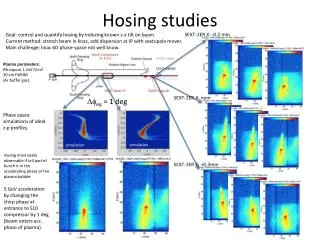
This study focuses on quantifying and controlling hosing effects in plasma accelerators by inducing a known z-x tilt on the beam. The current method involves stretching the beam in the linac and adding dispersion at the interaction point using a sextupole mover. One of the main challenges is the poorly known 6D phase space in the linac. The plasma parameters utilized include Rb vapor at 1.1e17/cm³ and a 30 cm FWHM with Argon buffer gas. Phase space simulations are conducted to observe the hosing phenomena, particularly when the tail of the bunch is in the accelerating phase of the plasma bubble, achieving 5 GeV acceleration.

Controlling Hosing in Plasma Accelerators via Induced Beam Tilt
E N D
Presentation Transcript
Hosing studies SEXT-2ER X: -0.2 mm Goal: control and quantify hosing by inducing known z-x tilt on beam. Current method: stretch beam in linac, add dispersion at IP with sextupole mover. Main challenge: linac 6D phase-space not well know. Plasma parameters: Rbvapour 1.1e17/cm3. 30 cm FWHM (Ar buffer gas). SEXT-2ER X: nom Dfeq = 1 deg Phase space simulations of ideal z-p profiles. simulation simulation Hosing most easily observable if tail part of bunch is in the accelerating phase of the plasma bubble: 5 GeV acceleration by changing the chirp phase at entrance to S10 compressor by 1 deg (beam enters acc. phase of plasma). SEXT-2ER X: +0.3mm