Exploring Restricted Matchings in Graphs: A Study on b-Matchings and Jump Systems
This research outlines various concepts and challenges related to restricted matchings in graphs, focusing on b-matchings and jump systems. The study addresses the Hamiltonian cycle problem, explores t-restricted k-matchings, and delves into augmenting connectivity by adding edges. It presents definitions, previous work, and the polynomial algorithms related to these problems, highlighting the relevance of forbidden subgraphs. The findings aim to provide deeper insights into the combinatorial properties of graphs, specifically regarding Hamiltonian cycles and matchings.

Exploring Restricted Matchings in Graphs: A Study on b-Matchings and Jump Systems
E N D
Presentation Transcript
Restrictedb-matchings Kristóf Bérczi Egerváry Research Group (EGRES) Eötvös Loránd University Budapest Kyoto 2012
Outline • Motivation • Definitions • Previouswork • Jumpsystems • ◊-free 2-matchings insubcubicgraphs • M-concavefunctions • Increasingnode-connectivitybyone • Polyhedraldescription • Conclusions
Hamiltonian cycleproblem Problem Given a graph G=(V,E), find a cyclecontainingeachnode. t-restrictedk-matchings t=1, k=2 Hartvigsen ’04 t < k Hartvigsen ‘12 Relaxation 1 • Find a subgraph • withdegrees ≤ 2 • containingno „small” components(number of edges > t) Lateron… Relaxation 2 • Find a subgraph • withdegrees ≤ 2 • containingno „short” cycles(lengthat most t)
Connectivityaugmentation Problem n-3 n-3 Make a graph G k-node-connectedbyadding a minimum number of newedges. Remark: edgeswill be chosenfromthecomplement of G n-4 n-4 n-4 n-4 Largek’s Smallk’s • k=2 Eswaran and Tarjan ‘76 • k=3 Watanabe and Nakamura ‘90 • k=4 Hsu ‘95 • fix k Jackson and Jordán ‘05 __ k=n-1 uniquesolution is G k=n-2 k=n-3 maximum matching in G • _ • subgraphin G with • degrees ≤ 2 • no cycle of length 4
Definition A b-matching is a subset F⊆E s.t. dF(v) ≤ b(v) foreachnodev. If=holdseverywhere, then F is a b-factor. G=(V,E) undirected, simple, b:V→Z+ Examples: b=1 b=2
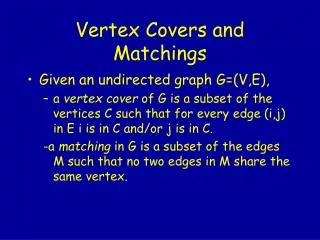
Definition A K-freeb-matchingcontains no member of K. LetK be a list of forbiddensubgraphs. Specialcases: A C(≤)k-free 2-matching contains no cycle of length(at most) k. Notation: C3=∆, C4=◊ Example: k=3 Hamiltonian relax.: C≤k-free 2-matching Node-conn. augmentation: C4-free 2-matching
Papadimitriu ’80, Hartvigsen ’84 Vornberger ’80 Vornberger ’ 80 • polynomial algorithm • weighted version NP - hard • NP - complete for the unweighted Nam ’94 case ◊ • polynomial algorithm for disjoint ’s Király ’01 • NP - hard for 0 - 1 weights Frank ‘03, Makai ‘07 • Kt,t-free t-matchingsinbipartitegraphsinbipartitegraphs Papadimitriu ’80, Király ’01 Vornberger ‘ 80 • NP - hard for 0 - 1 weights • NP - complete Makai ’08, Takazawa ’09 • node - induced weights Hartvigsen ’99, Király ’01, Pap ’05 Vornberger ’80 B. and Végh ’09, Kobayashi and Yin ’11 • Kt,t- and Kt+1-free t-matchingsindegree-boundedgraphs Vornberger ’80 Hartvigsen and Li ’07, • • NP - complete weighted version NP - hard Kobayashi ’09 polynomial algorithm • for general weights B. and Kobayashi ’09 polynomial algorithm for node - • induced weights Hartvigsen and Li ’11
Jumpsystems For x,y∈ZV, a vector s ∈ZV is an (x,y)-increment if • x(u) < y(u) and s =(0,…,0,1,0,…,0)= χu, or • x(u) > y(u) and s =(0,…,0,-1,0,…,0)= -χu forsome u ∈ V. u u Definition(Bouchet and Cunningham) J⊆ZV is a jump system if itsatisfies: (2-STEP)For any x,y∈J and for any (x,y)-increment s with x+s∉J, there exists an (x+s,y)-increment t such that x+s+t∈J. Definition J⊆ZV is a constantparityjump system if itsatisfies: (EXC) For any x,y∈J and for any (x,y)-increment s there existsan (x+s,y)-increment t such that x+s+t,y-s-t∈J.
Examples • Basefamily For a matroid M, J:={χB: B∈𝓑M} is a constant-parityjumpsystem. • Degree sequences I. The degreesequencesof all subgraphs in an undirected graphform a constant-parityjumpsystem. • Hyperplanes Let a∈{-1,0,1}S, let b∈Z, and let J={x∈ZS: ax=b}. Then J is a jumpsystem.
Examples • Degreesequences II. Degreesequences of C(≤)k-free2-matchings form a jump system for k≤3, but not fork≥5(Cunningham ‘02). Specialcases: • Cunningham’sconjecture • Kt+1- and Kt,t-free t-matchings Conjecture(Cunningham ‘02) The degreesequences of theC(≤)4-free 2-matchings form a jumpsystem. Theorem(Kobayashi, Szabó and Takazawa ‘12) Let H be a set of connected t-regular graphs.The degree sequences ofH-free t-matchings form a jump systemforanygraph G if and only ifeverymember ofHis a completepartitegraph.
Papadimitriu ’80, Hartvigsen ’84 Vornberger ’80 Vornberger ’ 80 • polynomial algorithm • weighted version NP - hard • NP - complete for the unweighted Nam ’94 case ◊ JUMP SYSTEM • polynomial algorithm for disjoint ’s NOT A JUMP SYSTEM JUMP SYSTEM Király ’01 • NP - hard for 0 - 1 weights Frank ‘03, Makai ‘07 • Kt,t-free t-matchingsinbipartitegraphsinbipartitegraphs Papadimitriu ’80, Király ’01 Vornberger ‘ 80 • NP - hard for 0 - 1 weights • NP - complete NOT A JUMP SYSTEM Makai ’08, Takazawa ’09 JUMP SYSTEM • node - induced weights Hartvigsen ’99, Király ’01, Pap ’05 Vornberger ’80 B. and Végh ’09, Kobayashi and Yin ’11 • Kt,t- and Kt+1-free t-matchingsindegree-boundedgraphs Vornberger ’80 Hartvigsen and Li ’07, • • NP - complete weighted version NP - hard Kobayashi ’09 polynomial algorithm • for general weights B. and Kobayashi ’09 NOT A JUMP SYSTEM JUMP SYSTEM polynomial algorithm for node - • induced weights Hartvigsen and Li ’11
Optimizationonjumpsystems For a set S⊆ZV , wedefineΦ(S)= maxv∈V{maxx∈Sx(v) - minx∈Sx(v)}. Assumethatfora b∈{0,1,2}V wecandecidewhetherthere is F⊆E withdF(v)=b(v) inγ1time( O(logn (n2/m)m√n), Goldberg and Karzanov ‘04). Theorem(Murota and Tanaka ‘06) J⊆ZV finite jump system, x0∈J,x∈J or not in γ time.Then we can findx∈J maximizing cx inO(n3log Φ(J) γ)time. Theorem(B. and Kobayashi ‘09) In subcubic graphs, the ◊-free 2-matching problem can be solved in O(n3 γ1)time.
Plan Determinewhether x∈Jsqin O(γ1) time Jsq={dM| M is a ◊–free 2-matching} is a jumpsystem Observethat (0,…,0)∈Jsq AND Φ(Jsq)≤3 Murota and Tanaka ‘06 Algorithmfor ◊–free 2-matchings insubcubicgraphs in O(n3γ1) time
Proof of Determinewhether x∈Jsqin O(γ1) time Definition(Shrinking a square) Shrinknode-disjointsquares C1,…,Cq , resultingin G'=(V',E'). Note: • G' mighthaveloopsand parallel edges, • if G is subcubicthensois G'. Let C=(v1,v2,v3,v4) be a square. Shrinking C consists of v1 v2 u1 u1 v4 v3 ‘square-edge’
Proof of Determinewhether x∈Jsqin O(γ1) time Step 1. Maximalfamily of disjoint◊’s with x(v)=2 foreach v. Step 2. Shrinkthe◊’s, define x' to be 2 forthenewnodes. 1 2 2 2 2 2 2 2 2 2 2 Lemma 2 2 x∈Jsq(G) if and onlyifx'∈J2(G'). 1 1 1
M-concavefunctions Definition For J⊆ZV, f:J->R is an M-concavefunctionon a constant-parityjump systemif itsatisfies: (M-EXC) For any x,y∈J and for any (x,y)-increment s, thereexists an (x+s,y)-increment t such that x+s+t∈J,y-s-t∈J, and f(x)+f(y)≤f(x+s+t)+f(y-s-t). Seeforexample: • weightedmatchingproblem • minsquarefactorproblem • weightedevenfactorprobleminodd-cyclesymmetricdigraphs
OptimizingM-concavefunctions Theorem(Murota and Tanaka ‘06) J⊆ZVfiniteconstant-parityjump system, f:J->Z M-concave, x0∈J, x∈J or not and evaluate f(x) in γ time.Then we can findx∈J maximizing f(x) inO(n3Φ(J) γ)time. Assumethatfor a weightedgraph and b∈{0,1,2}V wecanfind an F⊆E maximizing w(F) withdF(v)=b(v) inγ2time( O(n(m+nlogn)), Gabow ‘90). a a=p+r b=p+q c=q+s d=r+s p r b d q s c Theorem(B. and Kobayashi ‘09) In weightedsubcubic graphs, if w is vertexinducedoneverysquare, the weighted ◊-free 2-matching problem can be solved in O(n3 γ2)time.
Plan fsq(x)=max{Σe∈Mw(e)| M is a ◊–free 2-matching, dM=x} is an M-concavefunctiononJsq Calculatefsq(x) in O(γ2) time Observethat (0,…,0)∈Jsq AND Φ(Jsq)≤3 Murota and Tanaka ‘06 Algorithmforweighted ◊–free 2-matchings insubcubicgraphs and node-inducedweights in O(n3γ2) time
Proof of Calculatefsq(x) in O(γ2) time Step 1. Maximalfamily of disjoint◊’s with x(v)=2 foreach v. Step 2. Letπ be a functiononVsqinducing w. Step 3. Shrinkthe◊’s, define x' to be 2 forthenewnodes, and define w'. π5 π8 1 w(a) w(a)-π1 2 2 2 π1 π4 w(c) w(c)-π4-π5 2 2 2 π5+π6+π7+π8 π1+π2+π3+π4 2 2 2 2 π7 2 π6 2 π2 w(d) w(d)-π7 π3 w(b)-π3 w(b) 1 1 1 w(e) Lemma fsq(x)=f2(x')+π(Vsq) w'(M')=w(a)+w(c)+w(d)+w(e)+π2+π3+π6+π8 w(M)=w(a)+w(c)+w(d)+w(e) +π1+π3+π3+π2+π2+π4+π5+π8+π8+π6+π6+π7
Connectionwith ◊-free 2-matchings Wehaveseenthat Node-connectivityaugmentationto n-3 Max ◊-free 2-matching inthecomplement of G G is n-4 connected dG(v) ≥ n-4 foreach v dG(v)≤3 foreach v Node-connectivityaugmentation from n-4 to n-3 Max ◊-free 2-matching in a subcubicgraph
Corollary Theorem(B. and Kobayashi ‘09) Remark Végh ’09, Increasingnode-connectivitybyoneingeneral (‘Best StudentPaper’ prize, STOC’10). In subcubic graphs, the ◊-free 2-matching problem can be solved in O(n3 γ1)time. Corollary The connectivityaugmentationproblemfrom n-4 to n-3 can be solvedinO(n3 γ1)time.
Min-maxtheroem Theorem The maximum size of a 2-matching in G is equaltothe minimum of τ(U,S)=|V|+|U|-|S|+ΣT⌊½|E(T,S)|⌋, where U and S aredisjointsubsets of V, S is stable, and T ranges over thecomponents of G-U-S. τ(U,S)=2|U|+ΣT(|T|+⌊½|E(T,S)|⌋), T1 T2 Tk-1 Tk U S Theorem The maximum size of a 2-matching of a subcubic G is equaltothe minimum of τ(S)=|V|-|S|+ΣT⌊½|E(T,S)|⌋, where S is stable, and T ranges over thecomponents of G-S.
Min-maxtheroem Definition • C1,…,Cqdisjoint ◊’s, Sstableset. Wesaythat u,v areinthesameC-componentif • u and v areinthesamecomponent of G-S, or • u∈T1, v∈T2, and there is a cycleCi=(v1,v2,v3,v4) s.t. v1∈T1, v3∈T2,v2,v4∈S. • A square C=(v1,v2,v3,v4) fits a C-component T ifv1, v3∈T,v2,v4∈S. Inotherwords: a C-component is theunion of somecomponentsof G-S thatareconenctedwithcycles is a specialconfiguration. T1 T2 Tk-1 Tk U S
Min-maxtheroem Theorem(B. and Kobayashi ‘09) Proof • Shrinkthe ◊’s. • ObtainS'inG'for maximum 2-matching. • Blow back thesquares and followthechanges. Let G be subcubic, C a maximalset of disjoint ◊’s. The maximum size of a ◊-free 2-matching is equaltothe minimum of τ(S)=|V|-|S|+ΣT⌊½(|E(T,S)|-|CT|⌋-|K| where S is stable, and T ranges over theC-components of G-S, CTdenotestheset of ◊’s fitting T, and K is theset of K4’s.
The b-factorpolytope Definition matching The b-factorpolytope is theconvex hull of incedencevectorsof b-factors. matchings Definition (K,F) is a blossomif K⊆V, F⊆δ(K) and b(K)+|F| is odd. Theorem(Edmonds ‘65) The b-factorpolytope is determinedby matching ≤
The C(≤)k-freecase Canwegive a nicedescription of theweighted C(≤)k-free 2-matching (factor) polytope? no, if k≥4 Whataboutk = 3? Problem:Give a description of the∆-free 2-matching (factor) polytope. UNSOLVED! Vornberger ‘80
matchings Triangle-free 2-factors Theorem(Hartvigsen and Li ’07) Conjecture NOT TRUE! Forsubcubic G, the ∆-free 2-factor polytope is determinedby matchings ≤ ≤ ½ ½ 1 ½ ½ 1 1 ½
Tri-combs Definition (K,F,T) is a tri-combif K⊆V, T is a set of ∆’s „fitting” K, F⊆δ(K) and |T|+|F| is odd. Assume (K,F,T) is a tri-comb, M is a Δ-free 2-matching. Then • 2|M∩E[K]|+|M∩δ(K)| ≤ 2|K| • |M∩F|+|M∩T| ≤ |F|+2|T| • |M∩E[K]∩T| ≤ |T| • -|M∩δ(K)\(F∪T)| ≤ 0 Togethergives: 2|M∩E[K]|+2|M∩F|+2|M∩T| ≤ 2|K|+|F|+3|T|
Triangle-free 2-matchings Theorem(Hartvigsen and Li ’12) Forsubcubic G, the ∆-free 2-matching polytope is determinedby
Conclusions Open problems: • Maximum ◊-free 2-matching ingeneralgraphs Jsqis a jumpsystem The algorithmfortheΔ-freecase is reallymessy. • Maximum-weightΔ-free 2-matching ingeneralgraphs • Polyhedraldescription of thecorrespondingpolytopes • Polytope of Δ-free 2-matchings ingeneralgraphs
Thankyouforyourattention!ご清聴ありがとうございましたThankyouforyourattention!ご清聴ありがとうございました