Metamorphic Rocks Study Guide: Types, Examples, and Processes
Understand the conditions causing metamorphism, types of rocks, how heat and pressure affect rocks, and the classification of metamorphic rocks. Explore regional and contact metamorphism processes in detail.

Metamorphic Rocks Study Guide: Types, Examples, and Processes
E N D
Presentation Transcript
1) Know conditions that cause metamorphism. • Heat and Pressure
1a. Where does heat and pressure come from? • Heat comes from the Earth’s mantle or magma. • Pressure come from overlaying rock.
2) Define foliated • It describes its thin flat layers found in most metamorphic rocks.
3) Know examples of foliated and non-foliated rocks • Granite------- Gneiss • Sandstone------ Quartzite • Limestone------- Marble • Shale-------- Slate
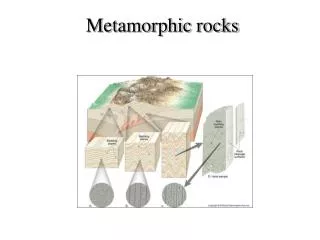
4) Know the types of metamorphism and how they occur • The 2 major types of metamorphism are region and local. • Regional- forms most of the metamorphic rock that makes up Earth’s crust.
4) Cont. • Local- two types • 1) Contact- occurs when hot magma moves into rock, heating and changing it. • Low Pressure, High Temperature • 2) Deformational - occurs with low temperature and high pressures at faults in the Earth
5) What are parent rocks? • The original rocks that before metamorphism. • Example: Granite
6) What are daughter rocks? • The rock after metamorphism.. • Example: Gneiss
7) Where does heat and pressure come from? • Heat- Mantle or magma • Pressure- Overlaying rock
8) What happens to heat and pressure as you move further into the Earth • Heat and pressure will both increase.. • What do you think happens to metamorphism deep in the Earth?
9) What is regional metamorphism and how does it occur? • Regional- forms most of the metamorphic rock that makes up Earth’s crust. • Makes up most mountain ranges
10) What is contact metamorphism? • Contact- occurs when hot magma moves into rock, heating and changing it. • Low Pressure, High Temperature
11)How are metamorphic rocks classified? • Foliated and non-foliated.