Understanding Inductance and Magnetic Fields in Solenoids: A Faraday Quiz
Dive into the fascinating world of electromagnetism with our engaging quiz focused on Faraday's principles. Explore how current behaves when a switch is closed, and discover the relationship between induced EMF and inductance in solenoids. We'll cover key concepts such as back EMF, solenoid geometry, and the implications of applying voltage to coils in a transformer setup. Perfect for enhancing your understanding of electrical circuits and magnetic fields. Join us to strengthen your grasp of these essential physics concepts!

Understanding Inductance and Magnetic Fields in Solenoids: A Faraday Quiz
E N D
Presentation Transcript
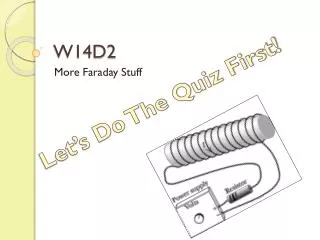
W14D2 More Faraday Stuff Let’s Do The Quiz First!
C O U N T D O W N
Back to Faraday – Turn on the current • Close the switch and the current will start to increase. • The coil will produce a “back” emf to oppose the current. • That back emf will be proportional to the rate of change of the current (and the field in the solenoid) • This means that L is the Inductance measured in henries (h)
Induced EMF in a Solenoid Recall that for a long solenoid we used Ampere’s Law to obtain the field in the interior. where n is the number of turns per unit length in the solenoid
More Better … Note that L depends only on the geometry of the solenoid.
I n d u c t a n c e
A New Kind of Circuit emf Similar solution to capacitor charge/discharge
Same ole same ole What would the short look like? Review this in the textbook – (968-9)
Let’s do some presentations from the last activity that we didn’t quite finish.
If a voltage V1=V0Sinwt is applied to the primary side of this device, what does V2 look like? The two coils are wrapped around a square metal support that carries the flux from one side of the transformer to the other with little change. In other words, the “core” maintains a constant magnetic flux throughout its structure. Coil: