The Mycenaeans (Day 2)
80 likes | 200 Vues
In 1874, Heinrich Schliemann unearthed the ancient Greek city of Mycenae, revealing a rich culture that thrived from 1600 to 1100 BC. His excavations uncovered numerous artifacts and unique tholos burial tombs filled with the spoils of war. The Mycenaeans developed a written language known as Linear B, deciphered in the 1950s but still shrouded in mystery. With evidence of Mycenaean influence in cities like Tiryns and Thebes, Schliemann’s discoveries raise questions about their mysterious collapse around 1200 BC and the possible link to the Trojan War.


The Mycenaeans (Day 2)
E N D
Presentation Transcript
The Mycenaeans (Day 2) By: Sean Rodriguez
Discovery! • Heinrich Schliemann: Excavated an ancient Greek city called Mycenae in 1874. • He found a vast culture within the structures filled with all sorts of artifacts. • The civilization seemed to have thrived in the years 1600-1100 BC.
Artifacts • Many artifacts were found in burial tombs that were filled with spoils of war. • The tombs were discoveries themselves as they had a unique bee-hive shape called tholos. http://travel.webshots.com/photo/2946223340059082311rlZrAd
Communication • The Mycenaeans developed a written language (much like the Minoans) called Linear B. • It was deciphered by Michael Ventris in the 1950’s. However it still didn’t open up that much information about them. http://proteus.brown.edu/greekpast/4690
Other Major Mycenaean Sites • The cities of Tiryns, Athens, Orchomenus, and Thebes also had evidence of having Mycenaean influence.
Collapse of the Mycenaeans • Around 1200 BC, the palaces are burnt in all major Mycenaean cities, probably from warfare or revolt. • More places are destroyed fifty years later, people leave the cities at this point.
Possible Trojan War? • There is some evidence of a Trojan War at this time but the evidence is highly disputed. • Heinrich was heavily influenced by the tales of the Iliad and Odyssey, so his judgment might have been subjective. http://www.wired.com/science/discoveries/news/2008/04/dayintech_0424
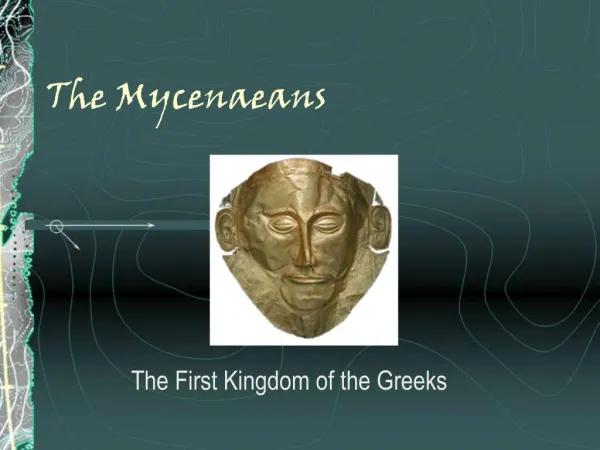
Evidence of Trojan War? • Heinrich found what he thought was the death mask of Agamemnon in a burial mound, however there is no scientific to support this. • He also found the tomb was filled with treasure which he believes was confiscated at Troy, however there is no real evidence of this either. http://www.artchive.com/artchive/G/greek/agamemnon.jpg.html