Understanding Actinomycosis: Causes, Symptoms, and Diagnosis of this Chronic Infection
200 likes | 311 Vues
Actinomycosis is a chronic infection primarily affecting the head and neck, characterized by open sinuses and abscess formation. Caused by various species of Actinomyces, normally non-pathogenic in the oral cavity, it can become infectious through trauma or dental procedures. The disease is more common in males between the 4th and 6th decades of life. It presents in three forms: cervicofacial, pulmonothoracic, and abdominopelvic, with distinctive clinical signs including hard lumps, fever, and possible pulmonary complications. Diagnosis includes clinical findings, Gram staining, and culture.


Understanding Actinomycosis: Causes, Symptoms, and Diagnosis of this Chronic Infection
E N D
Presentation Transcript
Definition: • Is a chronic infection, commonly involves head and Neck region. • Produces open Sinuses and abscess formation.
Causes and risk factors. . Five types have been described; A.Israeli,A.bovis,A.viscosus,A.naeslun-dii, A.odontolyticus. • Normally non pathogenic in the nose and throat. • It causes infection when introduced into the facial tissues by trauma, dental procedures etc. • May cause hard abscess and nodule formation; the lumpy jaw. • Except for bovis all are normal flora of the oral cavity.
Incidence: • Slight male preponderance.(1.5-1 to 3:1) • Usually 4th to 6th decade. • Can be divided into three distinct forms; Cervicofacial(50%),pulmonothoracic(30%) and abdominopelvic forms(20%).
Characteristics: • They are gram+ve rods. • Anaerobes • Branching and filamentous in morphology.
can also sometime cause pulmonary Actinomycosis. • Poor hygiene, dental abscess, alcohol abuse may result in pulmonary actinomycosis. • Causes lung cavities ,nodules and pleural effusions.
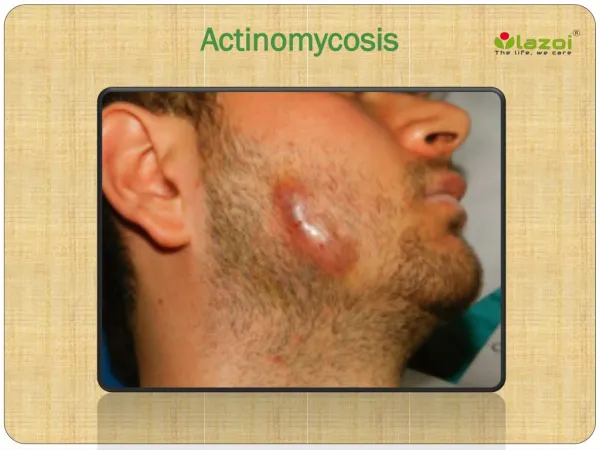
The Cervicofacial type; • Fever • Hard tender lumps with or without open sinuses mostly in and around the mandibular region • Sulfur granules in the abscess. (sulfur granules can be seen in nocardia infections but those are acid fast) • Wt. loss • Rarely with cervical lymphadenopathy. .
Pulmonothoracic type: • Poor hygiene, dental abscess, alcohol abuse may result in pulmonary actinomycosis. • Causes lung cavities ,nodules and pleural effusions.
Diagnosis: • Clinical findings. • Gram stain. • Culture. (poor growth in culture only in less than 50% of cases.) Sulphur granules (yellowish myecelial masses) • Specimens – open biopsy, aspiration material • The discharge should mix with sterile saline in a universal bottle and allow to stand, particles will separate out.
Causes granulomatous inflammation, like chronic abscess of the neck, appendix • Yellow granules in the discharge
Place between 2 slides • Crush and gram stain • Gram positive branching filaments
Complications: • Osteomyelitis(although not common). • Otitis media. • Meningitis. • Lung infections. • Laryngeal infections(rare0