
Development and Adoption of the New Baltic Sea Action Plan (BSAP)

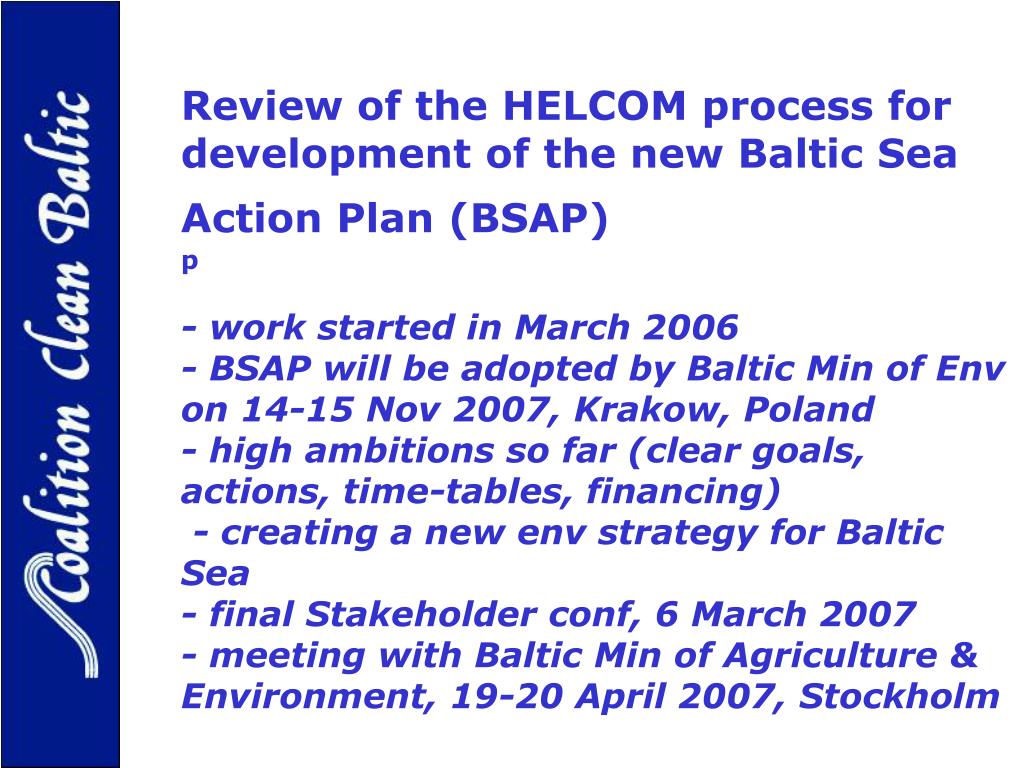
The Baltic Sea Action Plan (BSAP), initiated in March 2006, presents an ambitious framework to tackle environmental challenges in the Baltic Sea. Set to be adopted by the Baltic Ministers of Environment on November 14-15, 2007, in Krakow, Poland, the plan outlines clear goals, actions, and strategies, including nutrient quota systems, management of hazardous substances, and the protection of biodiversity. Key stakeholders have raised concerns about eutrophication, agriculture impacts, and national resistance, particularly from Denmark and Poland. This collaborative effort seeks to promote sustainability and address maritime activities and ecosystems.
Télécharger la présentation 
Politique de téléchargement : le contenu du site vous est fourni TEL QUEL pour votre information et votre usage personnel ; il ne peut être vendu, concédé sous licence ni partagé sur d’autres sites sans l’accord de son auteur.Le contenu vous est fourni TEL QUEL, pour votre information et votre usage personnel uniquement. Téléchargez la présentation en cliquant sur ce lien. Lors du téléchargement, si vous ne parvenez pas à télécharger une présentation, l’éditeur a peut-être supprimé le fichier de son serveur.Pendant le téléchargement, si vous ne parvenez pas à obtenir une présentation, le fichier a peut-être été supprimé par l’éditeur.
F I N