Understanding Mineral Classes and Their Physical Properties
This guide explores the diverse classes of minerals and their physical properties, essential for identifying and classifying minerals. We delve into components like hardness, luster, streak, cleavage, and fracture, highlighting examples from various mineral classes including elements, sulfides, halides, and silicates. By understanding these properties, we gain insights into mineral formation and applications in fields such as geology, materials science, and resource management. A solid grasp of mineral characteristics enhances scientific literacy and appreciation for the natural world.

Understanding Mineral Classes and Their Physical Properties
E N D
Presentation Transcript
Minerals Physical Properties
What are we learning?
Why are we learning this concept?
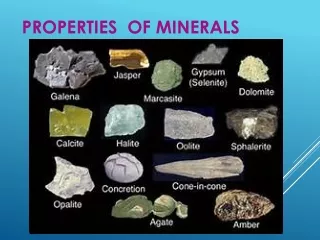
Classes of Minerals • Elements Class – metals/non-metals; composition is a metal, such as iron, combined with non-metallic elements such as carbon, nitrogen, phosphorous, and silicon; unique and rare; Ex: barringerite • Sulfides • Halides • Oxides • Carbonates • Sulfates • Phosphates • Silicates • The Organic Class • The Mineraloids
Hardness How easily a mineral is scratched. Reference: Mohs Scale Diamond, hardest known mineral, is rated 10 on the Mohs Scale & a Fingernail has a hardness rating of 2.5 on the Mohs Scale.
Luster The way a mineral reflects light. Two Main Categories: Metallic and Nonmetallic Metallic Submetallic Adamantine Resinous
Luster The way a mineral reflects light. Two Main Categories: Metallic and Nonmetallic Glassy/Vitreous Pearly Oily/Greasy Dull
Streak The color of a mineral in powdered form. Example: Gold – yellow streak Pyrite – greenish-black or brownish-black streak
Cleavage or Fracture Cleavage – breaks along smooth, flat surfaces (layers of paper). Fracture – uneven, rough, or jagged surfaces. Cleavage Fracture