Download
1 / 1
10 likes | 114 Vues
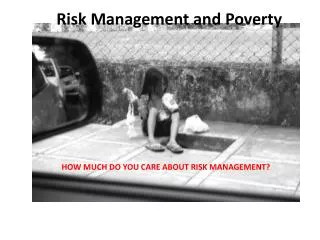
National risk management effectiveness is closely tied to poverty levels within a country. A lower poverty rate often signifies a more robust risk management system. However, formal strategies alone may not be enough to build resilience. The Philippines faces significant challenges due to its geographical location along the Pacific Ring of Fire, making it susceptible to various natural disasters. With over 268 disaster events recorded in three decades, collaboration between public and private sectors is essential to mitigate vulnerabilities and enhance the nation's resilience against catastrophic shocks.

E N D
Any nation’s risk management is as good as lesser poverty in the country. It is just to say also that the poverty level is an indication of how effective and efficient the national risk management system is. However, the formal risk management may not suffice to build up resilience. It takes joint efforts of the entire nation, and especially private enterprises and public entities, to eradicate the vulnerability of the country to disastrous shocks. Located along the western rim of the Pacific Ring of Fire and the Pacific typhoon belt, the Philippines is vulnerable to earthquakes, tsunamis, volcanic eruptions, landslides, floods, tropical cyclones, and drought. With 268 recorded disaster events over the past three decades and more than 40 million people affected between 2000 and 2010, the Philippines ranks eighth among countries most exposed to multiple hazards, according to the World Bank’s Natural Disaster Hotspot list. Risk Management and Poverty HOW MUCH DO YOU CARE ABOUT RISK MANAGEMENT?