Mariner 10: First Spacecraft to Visit Mercury and Utilize Gravity Assist
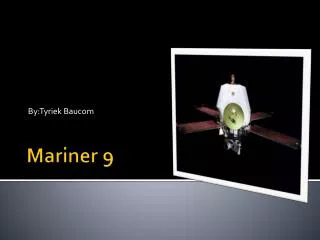
Mariner 10 was the seventh successful launch in the Mariner series and the first spacecraft to visit Mercury. It made history as the first to use the gravitational pull of Venus to reach Mercury, enabling a mission that explored two planets. The spacecraft completed three flybys of Mercury, returning groundbreaking images and data. Designed with an eight-sided magnesium structure, it featured solar panels that powered its instruments, weighing a total of 502.9 kg at launch. Mariner 10 provided the first close-up images of both Venus and Mercury.

Mariner 10: First Spacecraft to Visit Mercury and Utilize Gravity Assist
E N D
Presentation Transcript
Mariner 10 By:KhabrilKirkendall
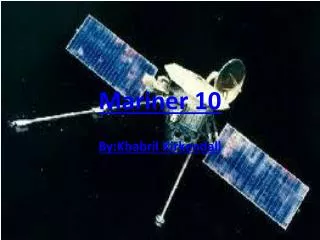
Mariner 10 • Mariner 10 was the seventh successful launch in the Mariner series and the first spacecraft to visit Mercury. It was also the first spacecraft to use the gravitational pull of one planet (Venus) to reach another (Mercury), and the first spacecraft mission to visit two planets. The spacecraft flew by Mercury three times in a retrograde heliocentric orbit and returned images and data on the planet. Mariner 10 returned the first-ever close-up images of Venus and Mercury.
Mariner Fun Facts • Spacecraft and Subsystems • The spacecraft structure was an eight-sided forger magnesium framework with eight electronics compartments. It measured 1.39 m diagonally and 0.457 m in depth. Two solar panels, each 2.69 m long and 0.97 m wide, were attached at the top, supporting 5.1 sq m of solar cell area. Fully deployed the spacecraft measured 8.0 m across the solar panels and 3.7 m from the top of the low-gain antenna to the bottom of the heat-shield. A scan platform with two degrees of freedom was mounted on the anti-sunward face. A 5.8 m long hinged magnetometer boom extended from one of the octagonal sides of the body. Total launch mass was 502.9 kg, of this 29 kg were propellant and attitude control gas. The total mass of instruments onboard was 79.4 kg.