Understanding Functions and Their Types: Injections, Surjections, and Bijections
This lecture dives into the concept of functions, their domains, and codomains, detailing how they associate elements from one set to another. It covers several types of functions including injections (one-to-one), surjections (onto), and bijections, explaining the conditions under which functions fall into these categories. Additionally, it highlights the importance of inverse functions, especially in the context of bijections, and demonstrates how to compose functions effectively. In-class exercises reinforce these concepts for better understanding.

Understanding Functions and Their Types: Injections, Surjections, and Bijections
E N D
Presentation Transcript
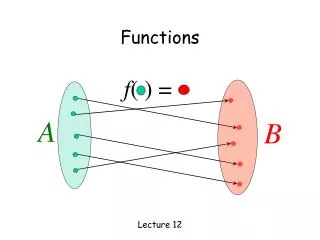
f( ) = A B Functions Lecture 12
Functions function, f, from set A to set B associates an element , with an element The domain of f is A. The codomain of f is B. For every input there is exactly one output.
Functions f(S) = |S| f(string) = length(string) f(student) = student-ID f(x) = is-prime(x)
f( ) = A B Injections (one-to-one) is an injection iff every element of B is f of at most 1 thing ≤ 1 arrow in |A| ≤|B|
f( ) = Surjections (Onto) is asurjectioniff every element of B is f of something 1 arrow in A B |A| ≥|B|
f( ) = A B Bijections is a bijection iff it is surjection and injection. exactly one arrow in |A| =|B|
Functions a. One-to-one, b. Onto, c. One-to-one, d. neither d. Not a Not onto not one-to-one and onto function a 1 a a 1 a 1 1 b 2 b 1 b 2 b 2 a 2 c 3 c 2 c 3 c 3 b 3 4 d 3 d 4 d 4 c 4 8
Inverse Sets A B Given an element y in B, the inverse set of y := f-1(y) = {x in A | f(x) = y}.
f( ) = A B Inverse Function Informally, an inverse function f-1 is to “undo” the operation of function f. exactly one arrow in There is an inverse function f-1 for f if and only if f is a bijection.
Composition of Functions Two functions f:X->Y’, g:Y->Z so that Y’ is a subset of Y, then the composition of f and g is the function g。f: X->Z, where g。f(x) = g(f(x)). Y’ Z X Y