Using FARS Queries For Concept Papers
This session focuses on utilizing the Fatality Analysis Reporting System (FARS) to identify and analyze data related to traffic fatalities. Participants will learn to identify data that best supports their specific problems, discuss how to express this data as statistics, and recognize traffic safety issues through detailed analysis. Key examples highlight the importance of restraint device use and pedestrian safety near crosswalks and bus stops. By the end, attendees will be equipped to formulate accurate statistical statements and identify trends that can guide resource allocation for improved traffic safety.


Using FARS Queries For Concept Papers
E N D
Presentation Transcript
Objectives By the end of this session, you will be able to: • Identify data to best support a given problem • Discuss various statements expressing data as a statistic • Recognize a problem by analyzing data
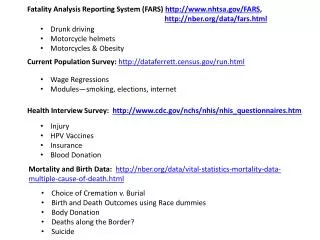
Fatality Analysis Reporting System (FARS) • Compilation of fatalities across US including: • Person types involved • Location of occurrence • Possible causes of each fatality • Pre-created tables of data • Tables created using Query
Example 1: Formulate Problem • Adults riding in vehicles without proper restraint device • Children riding in vehicles with out child restraint • Those without restraints in crashes resulting in injuries or death
Example 1: Determine Supporting Data • Identify the number of fatal injuries due to: • no restraint • improperly used restraint • List patterns common to larger groups of fatally injured, such as: • Age/race/income • Location/time of incident • Misuse of restraint
FAR Tables Find data using: • Pre-created Table • Create Table in Query
FARS Pre-created Tables Inspect tables to view different data types
FARS Tables Created by Query If data is not in pre-created table, start a query to create a table
FARS Tables Created by Query Choose a year
Example 1: FARS Table Choose an option for data sets (ex: Option 1)
Example 1: FARS Table Choose two data checkboxes (ex: “Age” and “Restraint System”)
Example 1: FARS Table • Narrow data results. Will show the two you chose, plus State will show as an option. (ex: “All” on all three)
Example 1: FARS Table • Choose which data for row and column of newly created table. (ex: chose “Age” and “Restraint System” as row and column)
Example 2: Formulate Problem • Vehicles are not yielding to pedestrians at crosswalks • Pedestrians departing bus stops are not crossing safely
Example 2: Determine Supporting Data • Identify the number of fatal injuries at: • Crosswalks • Bus stops • Other locations • List patterns common to larger groups of fatally injured, such as: • Age/race/income • Location/time of incident • Violations due to vehicle or pedestrian
Writing Statistical Statements • Must be believable/come from reliable sources • Example: 4 out of 5 dentists surveyed recommend X gum to their patients who chew gum. Who said that? • Find the trends in data to focus resources for the most impact • Persuasive language
Persuasive Words Source www.education.umd.edu
Statistical Statement Example 1 70.6% of fatalities reported were male • Where did this data come from? • How was this statistical percentage determined?
Statistical Statement Example 1 70.6% of fatalities reported were male • Document the source (ex. FARS) • Be prepared to show the math if asked 22,860 / 32,367 * 100 = 70.62749096301789
Expressing Statistical Statements A single set of data can be expressed different ways: • Most fatalities are male. • 2/3 of all fatalities are male. • Fatalities are 2 times as likely to be male. • Crashes fatalities are half as likely to be women Determine which way is most relevant to your problem (makes it sound reeaallyy bad)
Statistical Statement Example 2 4751 fatalities under 21 years of age in US 18,179 fatalities between ages 21 and 54 360+344+637+3410=4751 3,282+5,497+4,323+5,077=18,179
Find the Trend: Motorcycle Fatalities Motorcycles involved in fatal crashes per 100M VMT
Things to Avoid • Let the data speak: do not misrepresent the data. • Do not manipulate the data so that there is no way to recalculate a percentage • Avoid using “average” and “you” • Use “we and us” only when you have proper authority • Ex: somebody call 911
Other Data Sources Other sources contain crash, injury and fatality data: • Florida Crash Facts • National Center for Statistics and Analysis (NCSA)
Objectives Review You should now be able to: • Identify data to best support a given problem • Discuss various statements expressing data as a statistic • Recognize a problem by analyzing data